Peptid-Lexikon
Methylenblau
Phenothiazin-Farbstoff und Redox-Cycler, der Elektronen in der mitochondrialen Atmungskette übertragen kann.
| Substanzklasse | Small Molecule |
|---|---|
| CAS-Nummer | 61-73-4 |
| Summenformel | C₁₆H₁₈ClN₃S |
| Molmasse | 319,9 g/mol |
| Synonyme | Methylthioniniumchlorid, CI 52015 |
| PubChem | CID 6099 |
Struktur
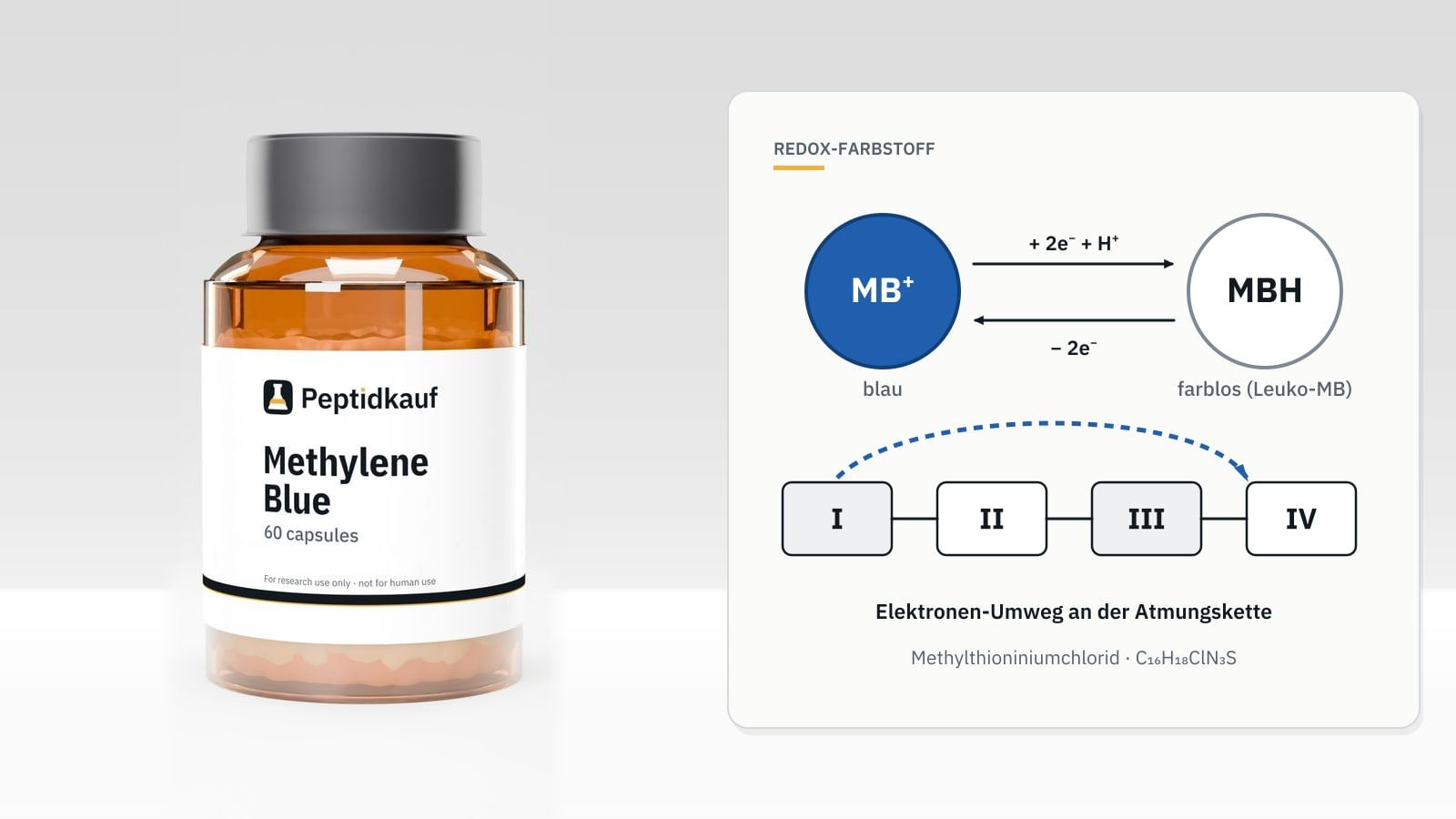
Methylenblau (Methylthioniniumchlorid, C₁₆H₁₈ClN₃S) wechselt zwischen oxidierter blauer Form und reduziertem, farblosem Leukomethylenblau. Diese Redox-Eigenschaft macht es zu einem klassischen Laborfarbstoff und Elektronenüberträger.
Forschungsschwerpunkte
Untersucht werden der Elektronentransfer an Komplex I–IV vorbei, die Sauerstoffverwertung, Monoaminoxidase-Hemmung und Modelle neurodegenerativer Erkrankungen; in der Mikroskopie dient es als Färbemittel.
Einordnung
Methylenblau ist als Arzneistoff für bestimmte Indikationen zugelassen. Das hier angebotene Material ist ein Forschungsreagenz.
Literatur
- Methylene blue in sepsis and septic shock: a systematic review and meta-analysisFront Med (Lausanne), 2024 · PMID 38698779 · DOI 10.3389/fmed.2024.1366062
- Methylene Blue in Septic Shock: A Systematic Review and Meta-AnalysisCrit Care Explor, 2024 · PMID 38904978 · DOI 10.1097/CCE.0000000000001110
- Methylene Blue: An Antidote for Methemoglobinemia and BeyondPediatr Emerg Care, 2021 · PMID 34463662 · DOI 10.1097/PEC.0000000000002526
- Vasoactive-Inotropic Score: Evolution, Clinical Utility, and PitfallsJ Cardiothorac Vasc Anesth, 2021 · PMID 33069558 · DOI 10.1053/j.jvca.2020.09.117
- Management of Refractory Anaphylaxis: An Overview of Current GuidelinesClin Exp Allergy, 2024 · PMID 38866583 · DOI 10.1111/cea.14514