Peptide nomenclature: how to read sequences
Peptidkauf Redaktion3 min read
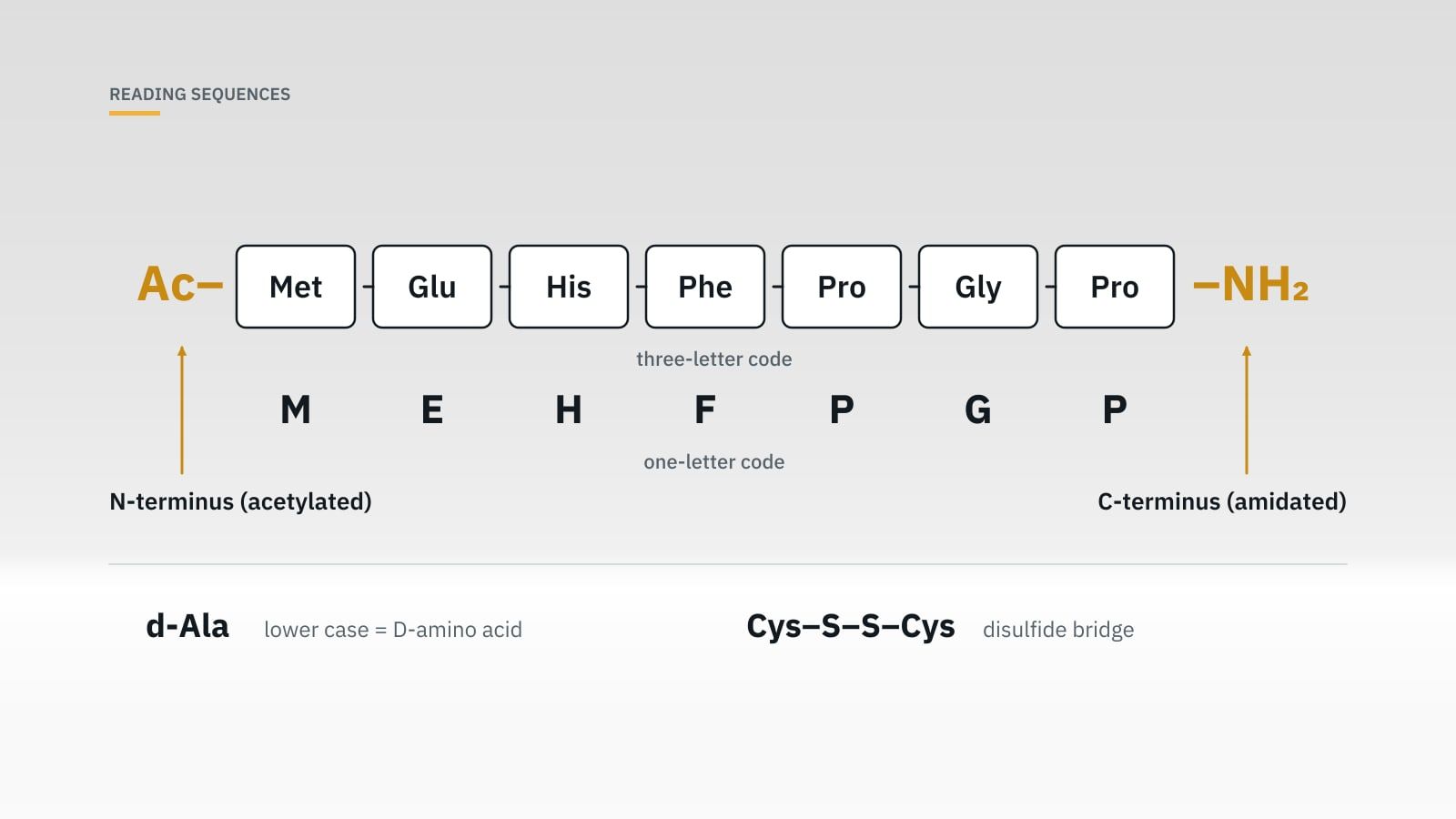
Data sheets and certificates of analysis often give a peptide's sequence as a string of letters, hyphens and abbreviations. Knowing the notation lets you compare products, match literature and avoid errors in your own records. This article explains the main conventions.
Direction: N- to C-terminus
Every peptide chain has two ends. At the N-terminus the first amino acid has a free amino group; at the C-terminus the last has a free carboxyl group. By international convention sequences are always written from N- to C-terminus, so "Gly-His-Lys" is a different molecule from "Lys-His-Gly".
Three-letter and one-letter codes
Each proteinogenic amino acid has two abbreviations, defined by the IUPAC-IUB commission:
| Amino acid | Three letters | One letter |
|---|---|---|
| Glycine | Gly | G |
| Alanine | Ala | A |
| Proline | Pro | P |
| Lysine | Lys | K |
| Arginine | Arg | R |
| Glutamic acid | Glu | E |
| Aspartic acid | Asp | D |
| Glutamine | Gln | Q |
| Asparagine | Asn | N |
| Tryptophan | Trp | W |
| Tyrosine | Tyr | Y |
| Phenylalanine | Phe | F |
| Cysteine | Cys | C |
| Methionine | Met | M |
| Histidine | His | H |
| Serine / threonine | Ser / Thr | S / T |
| Valine / leucine / isoleucine | Val / Leu / Ile | V / L / I |
In three-letter code residues are joined by hyphens (Gly-His-Lys); in one-letter code they run together (GHK). Long sequences are usually given in one-letter code, often in blocks of ten.
Terminal modifications
- Ac- at the start means an acetylated N-terminus, which removes the positive charge and can slow degradation by aminopeptidases.
- -NH2 at the end means a C-terminal amide instead of a free acid; many natural peptide hormones occur this way.
- -OH at the end explicitly denotes the free acid.
- pGlu or Pyr stands for pyroglutamic acid, a cyclised N-terminus.
An example is "Ac-SDKP", an N-terminally acetylated tetrapeptide.
D-amino acids and special building blocks
Natural amino acids are almost always L-form. A deliberately incorporated D-form is marked with a "D-" prefix (D-Ala) or, in one-letter code, often with a lowercase letter (a instead of A). Non-proteinogenic building blocks have their own abbreviations, such as Aib for α-aminoisobutyric acid or Dmt for 2,6-dimethyltyrosine, found in SS-31.
Rings and bridges
Two cysteines can form a disulfide bridge, often indicated as "(disulfide: Cys2–Cys7)" or with a bracket over the residues. The prefix "cyclo-" describes peptides whose ends are joined.
Salt form and counter-ions
Many synthetic peptides are supplied as acetate or trifluoroacetate (TFA) salts, often noted after the sequence ("× CH3COOH", "TFA salt"). The salt changes the molar mass of the material, not the sequence, so for concentration calculations it matters whether an amount refers to the salt or the free peptide — see Endotoxin and water content.
How to check a sequence
- Does the sequence match on data sheet, label and certificate?
- Are terminal modifications (Ac-, -NH2) stated and consistent with the literature?
- Does the measured mass on the certificate match the calculated mass of this sequence?
Calculated formulas and masses for every peptide in the range are in the Peptide lexicon.
Conclusion
Peptide sequence notation is compact but unambiguous. Knowing direction, codes and modifications lets you match material and literature reliably and avoid mix-ups in documentation.