Peptides vs. proteins: what is the difference?
Peptidkauf Redaktion2 min read
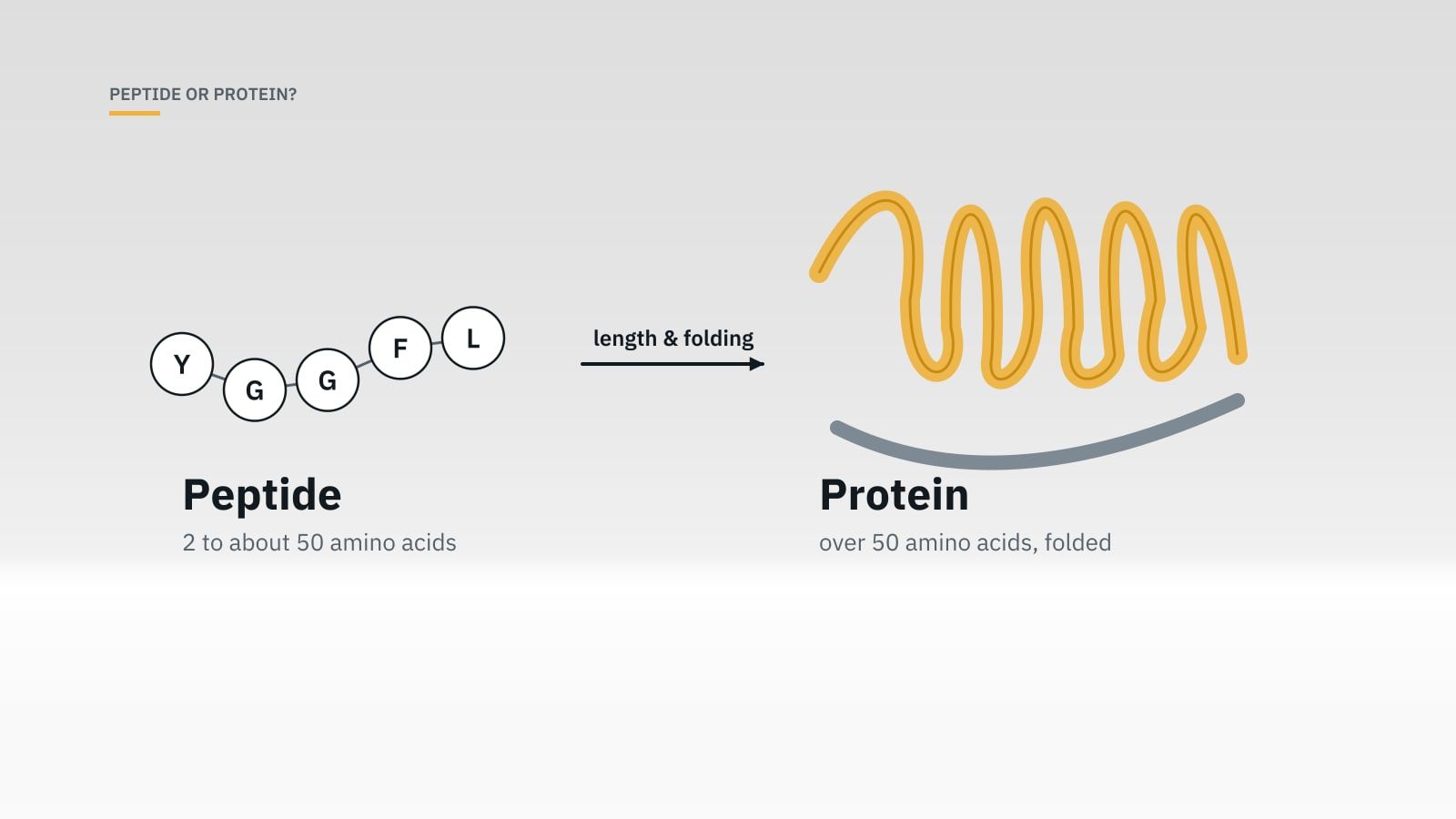
Peptides and proteins are often mentioned in the same breath. Both are chains of amino acids linked by peptide bonds. Yet they differ in size, structure, manufacture and behaviour in the lab. This article sorts out the terms. It covers biochemistry basics and contains no usage instructions.
The common basis: amino acids
Proteins and peptides use the same building blocks — in humans, 20 proteinogenic amino acids. Two amino acids join when the carboxyl group of one reacts with the amino group of the other, releasing water and forming a peptide bond.
Where is the boundary?
There is no binding international definition. Textbooks use a rule of thumb:
| Term | Typical length | Example |
|---|---|---|
| Dipeptide, tripeptide | 2–3 amino acids | Glutathione (3) |
| Oligopeptide | up to about 20 | BPC-157 (15) |
| Polypeptide | about 20–50 | Thymosin beta-4 (43) |
| Protein | from about 50 | Insulin, with 51, is a borderline case |
More important than the number is whether the chain adopts a stable three-dimensional structure.
Structure: the real difference
Proteins fold into a defined shape: primary structure (sequence), secondary structure (helices and sheets), tertiary structure (the fold of the whole chain) and, for some, quaternary structure of several subunits. Their function often depends entirely on this fold; unfolded by heat or solvent, they usually lose activity.
Short peptides often have no stable tertiary structure. In solution they exist as flexible chains in many conformations. Some are stabilised by cyclisation or disulfide bridges; others adopt their active form only when binding a target.
Manufacture in the lab
Peptides are usually made by chemical synthesis. The standard method is solid-phase peptide synthesis, described by Robert Bruce Merrifield in 1963 (Nobel Prize 1984). The chain is built one amino acid at a time on a resin. It is efficient up to about 50 residues; beyond that yields drop because small errors accumulate at every step.
Proteins are usually produced recombinantly in bacteria, yeast or cell culture. That allows very long chains and correct folding but brings other impurities, such as host-cell proteins or endotoxins.
What this means for analytics
For synthetic peptides, HPLC and mass spectrometry are standard: HPLC shows how much of the material is the target sequence; mass confirms identity. Typical by-products are deletion sequences missing one amino acid or truncated chains — see How to read a chromatogram.
Proteins raise further questions — correct folding, aggregates, modifications such as glycosylation — requiring methods like size-exclusion chromatography or circular dichroism.
Stability compared
Short peptides usually store well as lyophilisate; in solution they can hydrolyse, oxidise or deamidate. Proteins are additionally sensitive to unfolding and aggregation. General rules are on the Storage & handling page.
Conclusion
Peptides and proteins are chemically related but not the same. The boundary at about 50 amino acids is a convention; what matters is whether the chain has a stable fold. In the lab this means different manufacturing routes, impurities and test methods. More basics: What are peptides?