SS-31 (elamipretide): from lab peptide to first approval
Peptidkauf Redaktion3 min read
SS-31 is one of the few research peptides whose path led to a medicine approval, albeit by detours. As elamipretide, a finished product has had US approval since 2025 for a very rare inherited disease. Before that a large trial failed, and the approval itself rests on a narrow basis. The story shows well how research, clinical trials and approval relate. This article tells it in stages and contains no usage or dosing advice.
At a glance
- SS-31 and elamipretide are two names for the same tetrapeptide (D-Arg-Dmt-Lys-Phe-NH2).
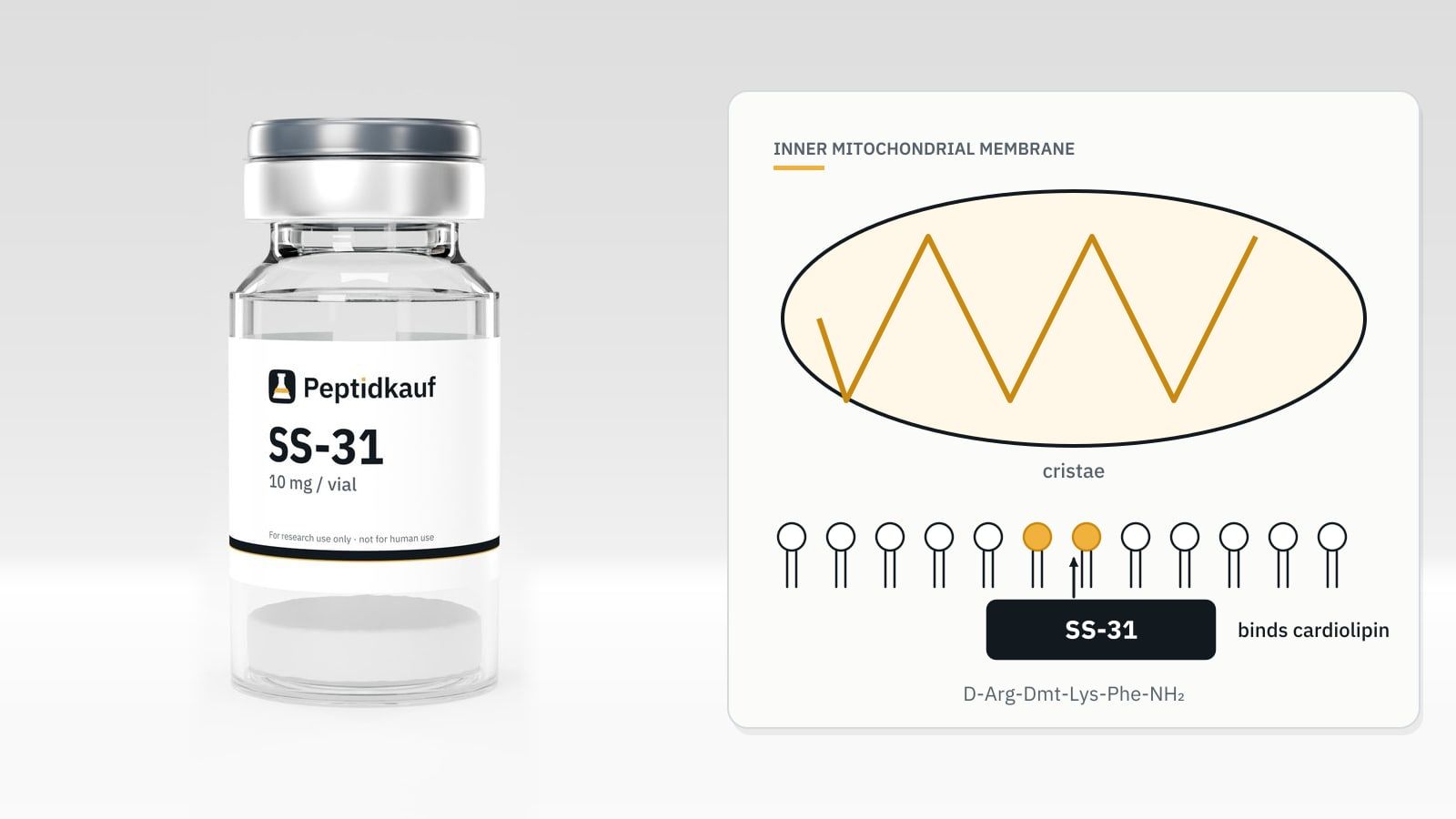
- It binds cardiolipin in the inner mitochondrial membrane and is thought to stabilise its structure.
- A phase 3 trial in mitochondrial myopathy missed its primary endpoints in 2019.
- Accelerated US approval followed in 2025 for Barth syndrome; elamipretide is not approved in the EU.
Stage 1: a peptide that reaches mitochondria
In the early 2000s Hazel Szeto and Peter Schiller developed short peptides that enter cells despite a positive charge, thanks to alternating aromatic and basic residues including a D-arginine and a 2′,6′-dimethyltyrosine. SS-31, the 31st of the series, accumulated in the inner mitochondrial membrane, where the respiratory chain sits.
Stage 2: cardiolipin as target
The inner membrane is folded into cristae held together by the lipid cardiolipin. SS-31 is thought to bind cardiolipin and stabilise the membrane. In cell and animal models of heart, kidney, eye and ageing, energy production and oxidative stress improved.
Stage 3: the large trial fails
| Trial | Population | Result |
|---|---|---|
| MMPOWER-3 (phase 3) | 218 people with primary mitochondrial myopathy | Both primary endpoints (walking distance, fatigue) missed at 24 weeks |
| TAZPOWER | 12 people with Barth syndrome | Primary endpoints missed in the randomised part; muscle strength rose in the open-label extension |
Stage 4: approval in Barth syndrome
Barth syndrome disturbs cardiolipin, exactly SS-31's target. Based on the rise in knee extensor strength in the TAZPOWER extension, the US Food and Drug Administration granted accelerated approval in 2025 for patients weighing at least 30 kg. Accelerated means it rests on an intermediate endpoint and a confirmatory trial must show clinical benefit.
What the approval does and does not mean
- It applies in the US, to one finished product and one narrow disease.
- It is provisional and can be withdrawn if confirmation fails.
- It says nothing about other diseases, healthy people or other preparations.
- In the EU elamipretide has orphan designation in development, but no approval.
In the lab
Because of its non-natural building blocks, identity confirmation by mass spectrometry is particularly important (639.8 g/mol). SS-31 is available with an independent report for every batch. Compare with MOTS-c vs. SS-31.
Frequently asked questions
Are SS-31 and elamipretide the same?
Yes. SS-31 is the research name, elamipretide the drug name.
Is SS-31 approved?
In the US a finished product has had accelerated approval for Barth syndrome since 2025; not in the EU.
Why is the approval debated?
Because it rests on a very small study and an intermediate endpoint, after a large trial in other muscle diseases failed.
Conclusion
SS-31 shows how long and uncertain the road from laboratory peptide to medicine is. For mitochondrial research it is an established tool; for claims about other uses there is no basis.