Are peptides legal? Research reagents, medicines and the rules
Peptidkauf RedaktionUpdated: 5 min read
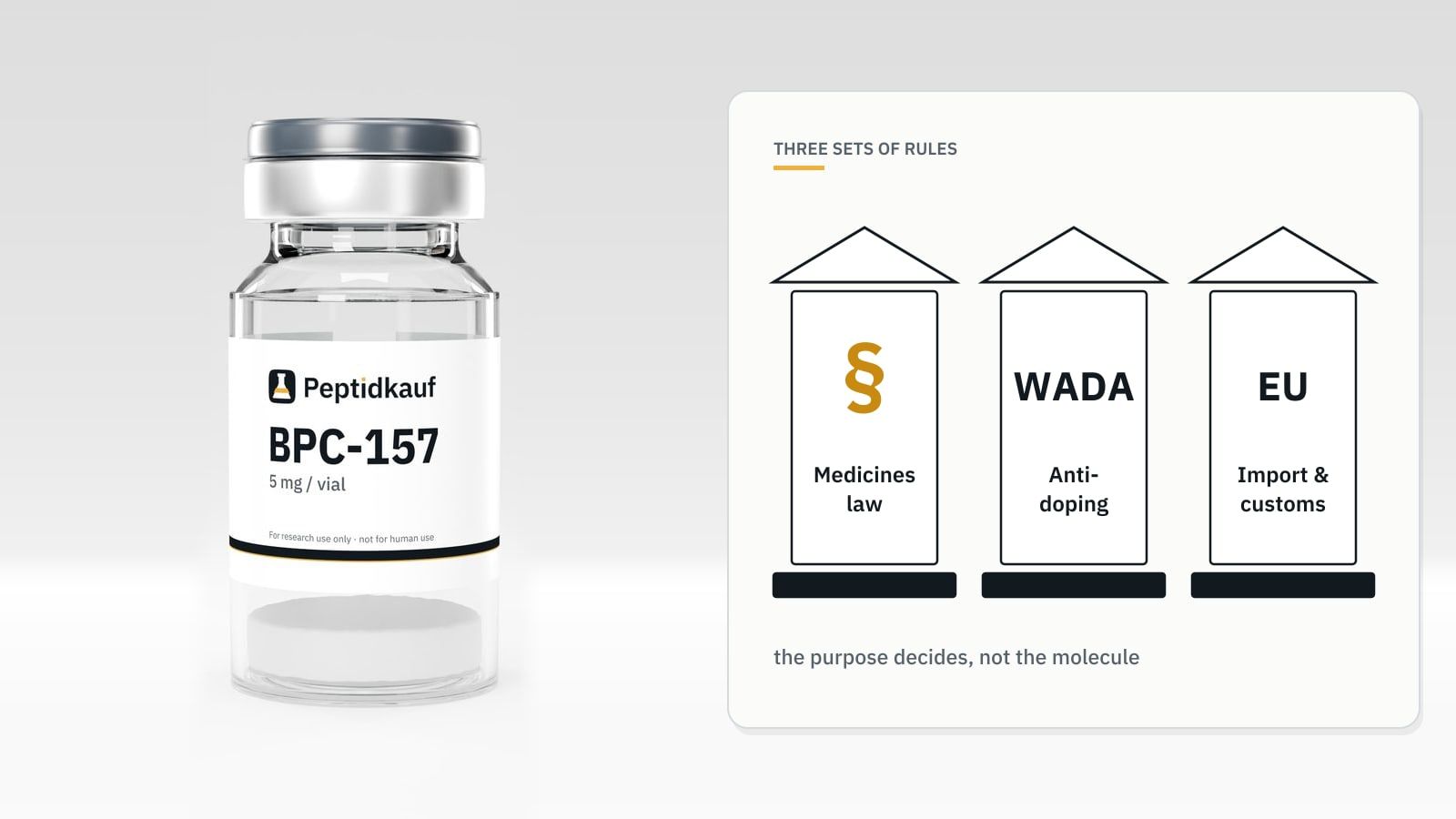
"Are peptides legal?" has no single answer, because "peptide" is a chemical description, not a legal category. The same molecule can be an approved medicine, an unapproved substance or a laboratory reagent, depending on how it is made, presented and used. This article explains the categories that matter, why the intended purpose is the deciding factor and how the rules differ between the EU and the US. It is a general overview, not legal advice. Our own sales rules are on the page about the legal status of research peptides.
Key points
- Legality depends on the substance, the intended purpose and the way a product is presented, not on the word "peptide".
- Medicines need an approval based on studies of quality, safety and efficacy.
- Research reagents are intended for laboratory work and are not medicines, foods or cosmetics.
- A "research use only" label does not help if everything else about a product suggests use in humans.
- Some peptides are additionally covered by anti-doping rules, regardless of their legal status elsewhere.
Peptides are a chemical class, not a legal one
Peptides are short chains of amino acids linked by peptide bonds. Insulin is a peptide, and so are many hormones, antibiotics and research tools. Law does not regulate "peptides" as such; it regulates products by category: medicines, foods and supplements, cosmetics, chemicals. Which category a product falls into decides which rules apply.
The categories that matter
| Category | Purpose | What is required |
|---|---|---|
| Medicine | Treating, preventing or diagnosing disease, or altering body functions | Marketing authorisation; usually prescription; manufacturing under GMP |
| Food and supplements | Nutrition | Food law; novel ingredients need their own authorisation |
| Cosmetics | External application to skin, hair or nails | Cosmetics regulation, safety assessment |
| Research reagent | Scientific laboratory work | Chemical and product-safety rules; no use in humans or animals |
Why the intended purpose decides
In both EU and US law, a product can become a medicine by its function or by its presentation. If a seller describes a peptide as a remedy, suggests dosages or shows it alongside injection advice, authorities can treat it as an unapproved medicine, whatever the label says. That is why serious suppliers of research reagents give no dosing or usage advice and keep their descriptions to identity, purity and laboratory handling.
The reverse also holds. A disclaimer such as "for research use only" is not a shield. Authorities look at the overall presentation: texts, images, product names, advertising and the customers addressed. A disclaimer that contradicts everything else carries little weight.
The EU and Germany
In the EU, medicinal products are defined by Directive 2001/83/EC; in Germany, the Medicines Act (Arzneimittelgesetz, AMG) implements this. Placing an unapproved medicine on the market is prohibited. Research reagents sold for laboratory use and presented as such are not medicines, but they are no loophole for human use either.
Two further sets of rules can apply. Anti-doping law (in Germany the Anti-Doping-Gesetz) prohibits possession of certain substances above defined amounts and their use in sport. And customs and import rules apply to shipments from outside the EU; goods that look like unapproved medicines can be detained.
The United States
In the US, the Federal Food, Drug, and Cosmetic Act gives the Food and Drug Administration (FDA) authority over drugs, foods, supplements and cosmetics. A product intended for use in humans to treat or affect the body is a drug and needs approval. Compounding pharmacies may prepare certain substances under specific lists and conditions, which is why FDA advisory votes on peptides such as BPC-157 or TB-500 attract attention. Such votes are recommendations about pharmacy lists, not approvals.
The FDA has repeatedly acted against sellers that market "research chemicals" with human-use claims. The legal test is the same as in the EU: intended use, judged from the overall presentation.
Anti-doping rules
The World Anti-Doping Agency (WADA) prohibited list covers many peptides regardless of whether they are approved anywhere, among them growth hormone fragments, growth hormone secretagogues, thymosin beta-4 and its derivatives, and metabolic modulators such as AMPK activators. For athletes subject to testing, possession and use can have consequences under sporting rules, and in some countries under criminal law.
What a responsible research supplier does
For buyers in a research setting, the practical questions are about documentation and presentation:
- Clear purpose. Products are described and sold as laboratory reagents, with no dosing, application or efficacy claims.
- Age and purpose confirmation. Buyers confirm they are adults and buy for research purposes.
- Batch documentation. Every batch comes with an independent analysis that can be verified at the lab; see the lab report archive.
- Transparent business data. A full imprint, VAT invoices and a reachable contact.
What the buyer then does with a substance is the buyer's responsibility, and whether holding a specific substance is permitted for a specific purpose can depend on the case. If in doubt, institutions and legal advisers are the right place to ask.
Common misconceptions
"If it's sold online, it must be legal." Availability says nothing about legal status for a given use.
"A research-use label makes anything allowed." The overall presentation decides, not a single sentence.
"An FDA vote means approval." Advisory votes on compounding lists are recommendations, not marketing authorisations.
"Legal in one country means legal everywhere." Medicines, anti-doping and import rules differ between countries.
Frequently asked questions
Is it legal to buy research peptides in the EU?
Research reagents that are sold and presented for laboratory use are generally not medicines. Use in humans is a different matter, and specific substances can be covered by anti-doping or other rules.
Why don't research suppliers give dosages?
Because dosing advice for humans would present the product as a medicine, which would require an approval it does not have.
Are approved peptide medicines the same as research reagents?
No. An approved medicine is a specific product with its own manufacturing, testing and conditions. A research reagent with the same active substance is a different product.
Is this article legal advice?
No. It is a general overview. For a specific situation, ask your institution or a legal adviser.
Conclusion
Whether a peptide is legal depends on what it is for and how it is presented. Medicines need an approval, research reagents belong in the lab, and anti-doping rules apply on top. Clear presentation, honest documentation and no claims about use in humans are what separate a research reagent from an unapproved medicine.