Bacteriostatic water: what it is and when you need it
Peptidkauf Redaktion2 min read
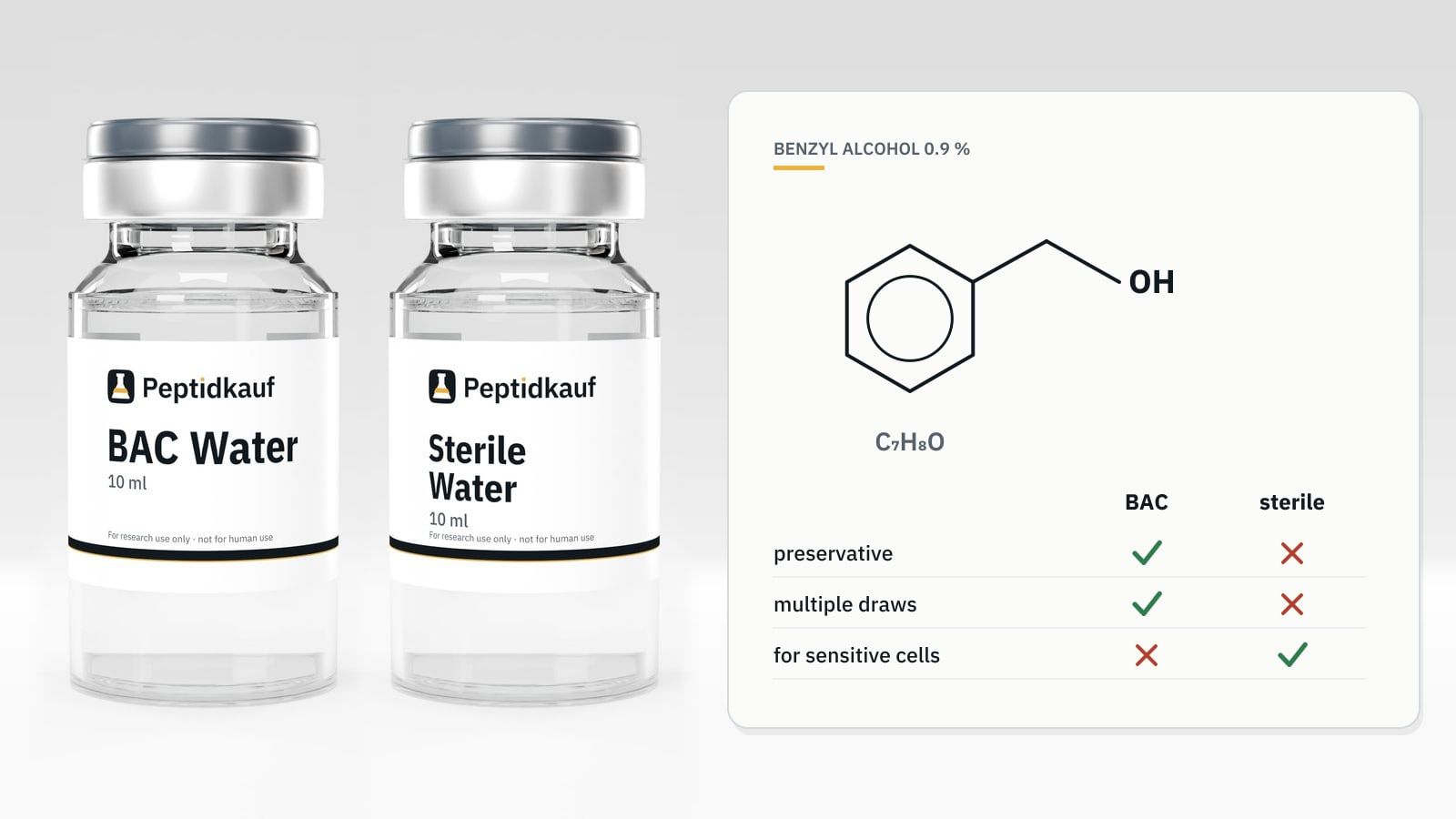
Freeze-dried peptides have to be dissolved before laboratory use, and the choice of solvent matters more than it seems. Bacteriostatic water is the most common choice. This article answers five questions: what it is, how it differs from sterile water, when to use which and how to store it.
At a glance
- Bacteriostatic water is sterile water with 0.9 % benzyl alcohol.
- The additive inhibits bacterial growth but does not reliably kill bacteria.
- It suits vials drawn from repeatedly; sterile water suits a single withdrawal.
- After first piercing, a vial is typically used for up to 28 days.
1. What does 'bacteriostatic' mean?
It means bacterial growth is inhibited; bactericidal would mean killed. At 0.9 %, benzyl alcohol stops germs introduced through the rubber stopper from multiplying. The water itself is filled sterile.
2. Bacteriostatic or sterile water?
| Property | Bacteriostatic water | Sterile water |
|---|---|---|
| Additive | 0.9 % benzyl alcohol | none |
| Withdrawal | repeated from one vial | single |
| After opening | up to 28 days is common | use immediately |
| Suited to | solutions used over days | experiments where benzyl alcohol could interfere |
In sensitive cell cultures or with peptides that tolerate alcohols poorly, sterile water is better; for stock solutions used over several days, bacteriostatic water is more practical.
3. How long does a pierced vial keep?
Multi-dose vials are typically used for up to 28 days after first piercing, refrigerated, with the stopper disinfected before each withdrawal. Unopened, store at room temperature protected from light; the label date applies.
4. How much solvent do you need?
That depends on the target concentration: 10 mg of peptide in 2 ml gives 5 mg per ml. Because the actual content can differ from the label, check the measured amount in the lab report. The peptide calculator does the arithmetic; technique is covered in reconstitution in vitro.
Frequently asked questions
What is the difference from saline?
Saline contains 0.9 % sodium chloride, bacteriostatic water 0.9 % benzyl alcohol; they serve different purposes.
Is bacteriostatic water suitable for every peptide?
For most. Some peptides or setups tolerate benzyl alcohol poorly; then sterile water is the better choice.
Conclusion
Bacteriostatic water is sterile water kept multi-use by a small additive. Knowing when benzyl alcohol interferes and how long a pierced vial lasts avoids the most common mistakes when preparing peptide solutions.