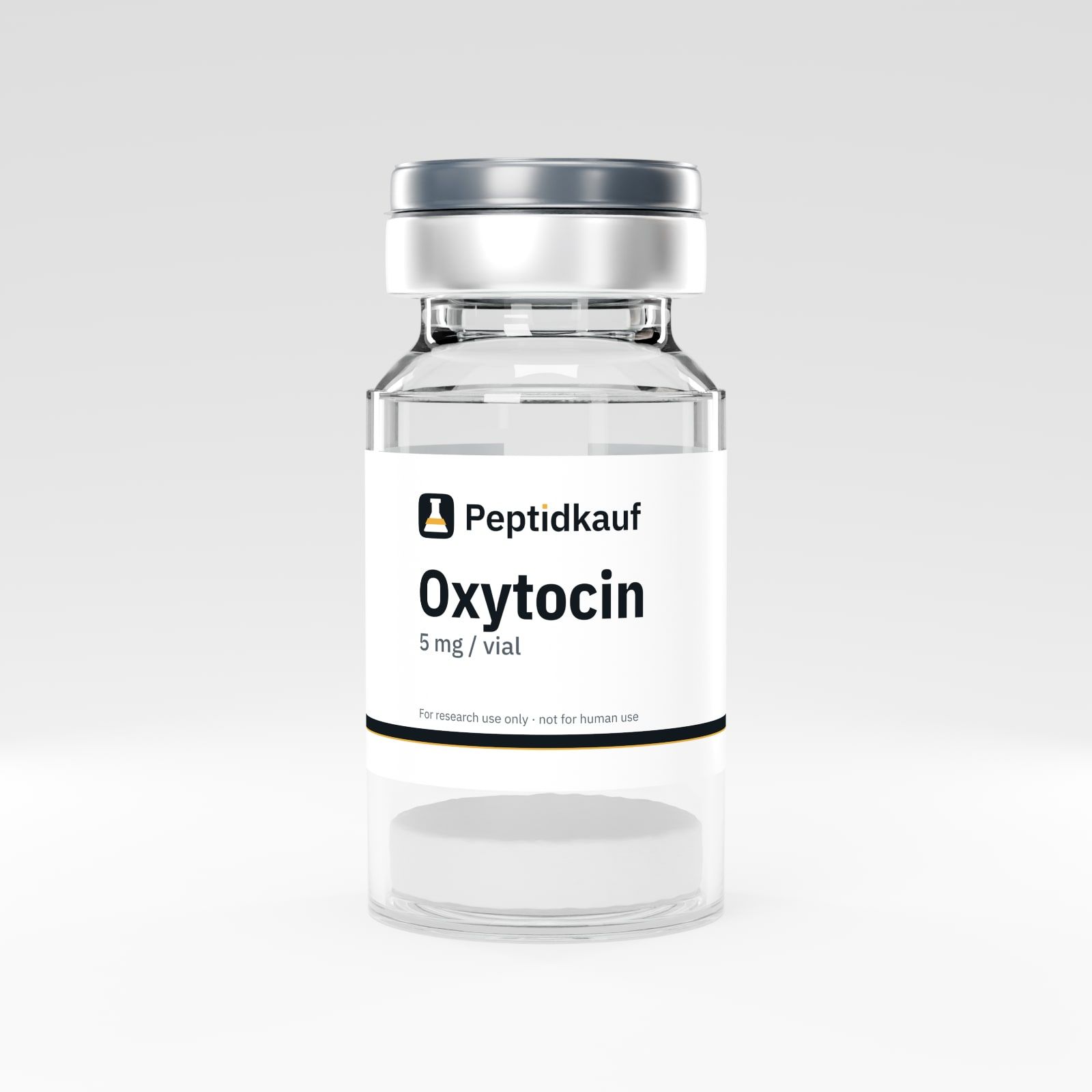



What is Oxytocin?
Oxytocin consists of nine amino acids (CYIQNCPLG-NH₂); the disulfide bridge between Cys1 and Cys6 forms a six-residue ring. It is produced in the hypothalamus and released from the posterior pituitary.
More data in the lexicon entry on Oxytocin.
State of research
In 1953 oxytocin became the first peptide hormone to be synthesised; Vincent du Vigneaud received the 1955 Nobel Prize in Chemistry for it. It acts through a G protein-coupled receptor in the uterus, mammary gland, heart and brain.
Neuroscience studies oxytocin in models of bonding, trust, anxiety and stress regulation. Many early findings with nasal spray in humans could not be reliably replicated, and how much peptide reaches the brain remains open. In cell and animal models it is the standard ligand for the oxytocin receptor.
Status and quality
Oxytocin is approved as an obstetric medicine. The material offered here is not a medicinal product. Peptidkauf sells Oxytocin solely as a research reagent for laboratory and in-vitro use and gives no dosing or application advice.
An independent laboratory tests every batch for purity (HPLC), identity and measured content before it goes on sale; the reports and their verification keys are in the lab report archive. The material ships as lyophilised powder in a glass vial; storage and laboratory handling are covered under storage & handling.
Related products and articles
More neuropeptides: VIP, selank, semax. Pituitary axis peptides: TRH, gonadorelin.