GLP-1 agonists explained: from semaglutide to retatrutide
Peptidkauf Redaktion5 min read
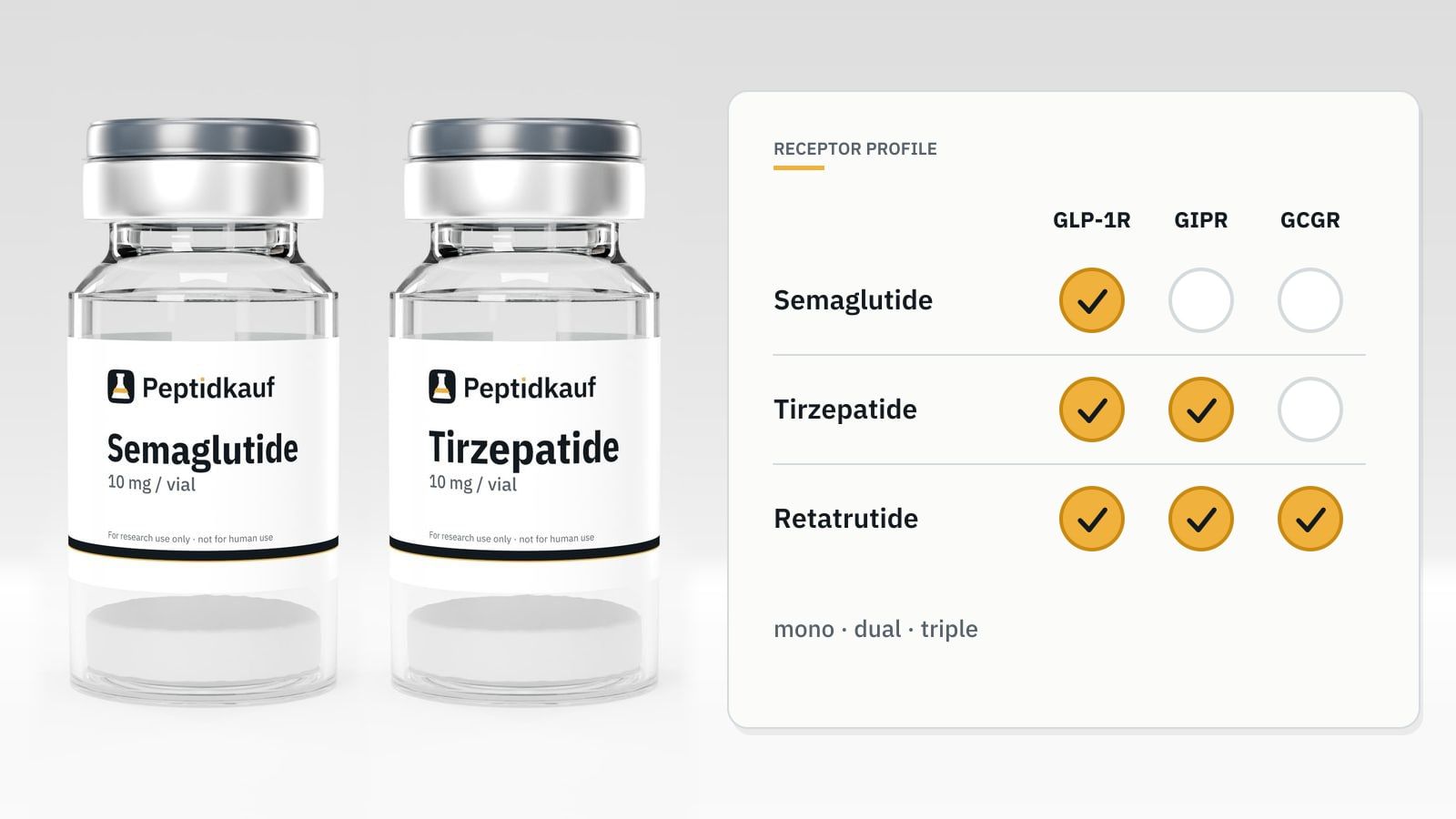
Few drug classes have changed medicine in recent years as much as the GLP-1 agonists. First developed for type 2 diabetes, they are now best known as weight-loss injections. Alongside them, research into successors that act on two or three hormone receptors at once is growing. This article explains what GLP-1 is, how the agonists work, which compounds are approved and which are still under investigation. It describes research and regulatory status and contains no usage or dosing advice.
At a glance
- GLP-1 is a gut hormone that increases insulin release after meals and dampens appetite. In the body it is degraded within minutes.
- GLP-1 agonists are stabilised versions that act for days. Semaglutide and tirzepatide are approved in the EU.
- Newer compounds combine GLP-1 with GIP, glucagon or amylin; retatrutide, mazdutide and survodutide are not approved.
- "GLP-1 capsules" from drugstores and online shops usually contain no GLP-1 agonist.
What is GLP-1?
GLP-1 stands for glucagon-like peptide-1. It is a 30-amino-acid peptide hormone released by specialised cells of the gut wall after a meal. GLP-1 is an incretin, one of the gut hormones that amplify the insulin response to food. The other important incretin is GIP.
GLP-1 acts in several places:
- Pancreas: increases insulin release, but only when blood glucose is raised, and inhibits glucagon.
- Stomach: slows gastric emptying.
- Brain: strengthens the feeling of fullness.
The natural hormone has a catch: the enzyme DPP-4 breaks it down within minutes. That is far too short for a drug.
How do GLP-1 agonists work?
GLP-1 agonists are modified peptides that trigger the same response at the GLP-1 receptor as the natural hormone but stay in the body much longer. Individual amino acids are exchanged so that DPP-4 can no longer cleave them, and a fatty acid is attached that binds the blood protein albumin. Semaglutide, for example, stays in circulation for about a week.
Because the receptor is activated continuously, the effects are stronger than with the natural hormone, especially on appetite. That is the source of the weight loss that made the class famous.
The generations at a glance
| Compound | Receptors | EU status (2026) |
|---|---|---|
| Liraglutide | GLP-1 | Approved (diabetes, obesity) |
| Semaglutide | GLP-1 | Approved (diabetes, obesity); also as a tablet |
| Tirzepatide | GIP + GLP-1 | Approved (diabetes, obesity) |
| Mazdutide | GLP-1 + glucagon | Not approved in the EU |
| Survodutide | GLP-1 + glucagon | Not approved, phase 3 |
| Retatrutide | GIP + GLP-1 + glucagon | Not approved, phase 3 |
| Cagrilintide | Amylin (studied with semaglutide) | Not approved |
| Orforglipron | GLP-1 (small molecule, not a peptide) | Not approved in the EU |
First generation: pure GLP-1 agonists
Exenatide, originally isolated from the saliva of a lizard, was the first compound of the class in 2005. Liraglutide and semaglutide followed. In the STEP 1 trial, adults with obesity lost about 15 per cent of body weight on average after 68 weeks with semaglutide, versus about 2 per cent on placebo.
Second generation: GIP and GLP-1
Tirzepatide also activates the GIP receptor. In the SURMOUNT-1 trial, mean weight loss in the highest dose group was about 21 per cent after 72 weeks. A comparison of the two is in tirzepatide vs. semaglutide.
Third generation: glucagon and amylin
The newest candidates add the glucagon receptor, which in models raises energy expenditure and fat breakdown in the liver. Mazdutide and survodutide combine GLP-1 and glucagon; retatrutide targets all three receptors. More in retatrutide: mechanism, trials and approval status. Another approach is amylin, a pancreatic hormone; the analogue cagrilintide is being studied together with semaglutide.
Tablets instead of injections: orforglipron
Peptides are digested in the stomach, which is why most GLP-1 agonists are injected. Semaglutide is also available as a tablet with an excipient that improves absorption. Orforglipron takes another route: it is not a peptide but a small molecule that activates the GLP-1 receptor and can be taken as a tablet.
What about "GLP-1 capsules"?
Products sold as "GLP-1 capsules" or "GLP-1 boosters" are food supplements, for example with plant extracts or fibre. They usually contain no GLP-1 agonist and are not comparable with approved medicines. Some ingredients are claimed to stimulate the body's own GLP-1 release; robust evidence of a relevant effect is mostly lacking.
Side effects of the drug class
The most common side effects are similar across all GLP-1-based drugs: nausea, vomiting, diarrhoea and constipation, especially at the start and when the dose is increased. Less common are pancreatitis and gallstones. Because the drugs suppress appetite strongly, part of the weight lost is muscle mass, which research is studying intensively. Approved GLP-1 agonists are prescription-only and belong under medical supervision.
GLP-1 analogues in research
In basic research, GLP-1 analogues are important tools, for example for studying receptor signalling, the brain's role in appetite regulation or effects on liver and blood vessels in cell and animal models. Because the compounds are chemically similar and often confused in the trade, identity testing by mass spectrometry is essential. Peptidkauf offers semaglutide, tirzepatide, retatrutide, mazdutide and survodutide as research reagents with a lab report for every batch, for laboratory use only.
Frequently asked questions about GLP-1
What is GLP-1?
A gut hormone that increases insulin release after meals, slows gastric emptying and dampens appetite.
What is a GLP-1 agonist?
A stabilised peptide or molecule that activates the GLP-1 receptor and acts much longer than the natural hormone.
Which GLP-1 agonists are approved?
In the EU these include liraglutide, semaglutide and tirzepatide. Retatrutide, survodutide and cagrilintide are not approved.
What is the difference between GLP-1 and GLP-3?
GLP-3 is not a hormone but a trade name for retatrutide, which activates the GIP and glucagon receptors as well as GLP-1.
Do GLP-1 capsules from the drugstore work?
These products usually contain no GLP-1 agonist. Their effect is not comparable with approved medicines.
Conclusion
GLP-1 agonists have grown from a diabetes drug into one of the most important drug classes. Research now goes beyond GLP-1 and combines several hormones in one molecule. Only a few of these are approved so far; the newest compounds are still in trials. Keeping the terms apart makes it easier to see which figures come from which trials and what they mean.