TB-500 and thymosin beta-4: two names, two molecules
Peptidkauf Redaktion2 min read
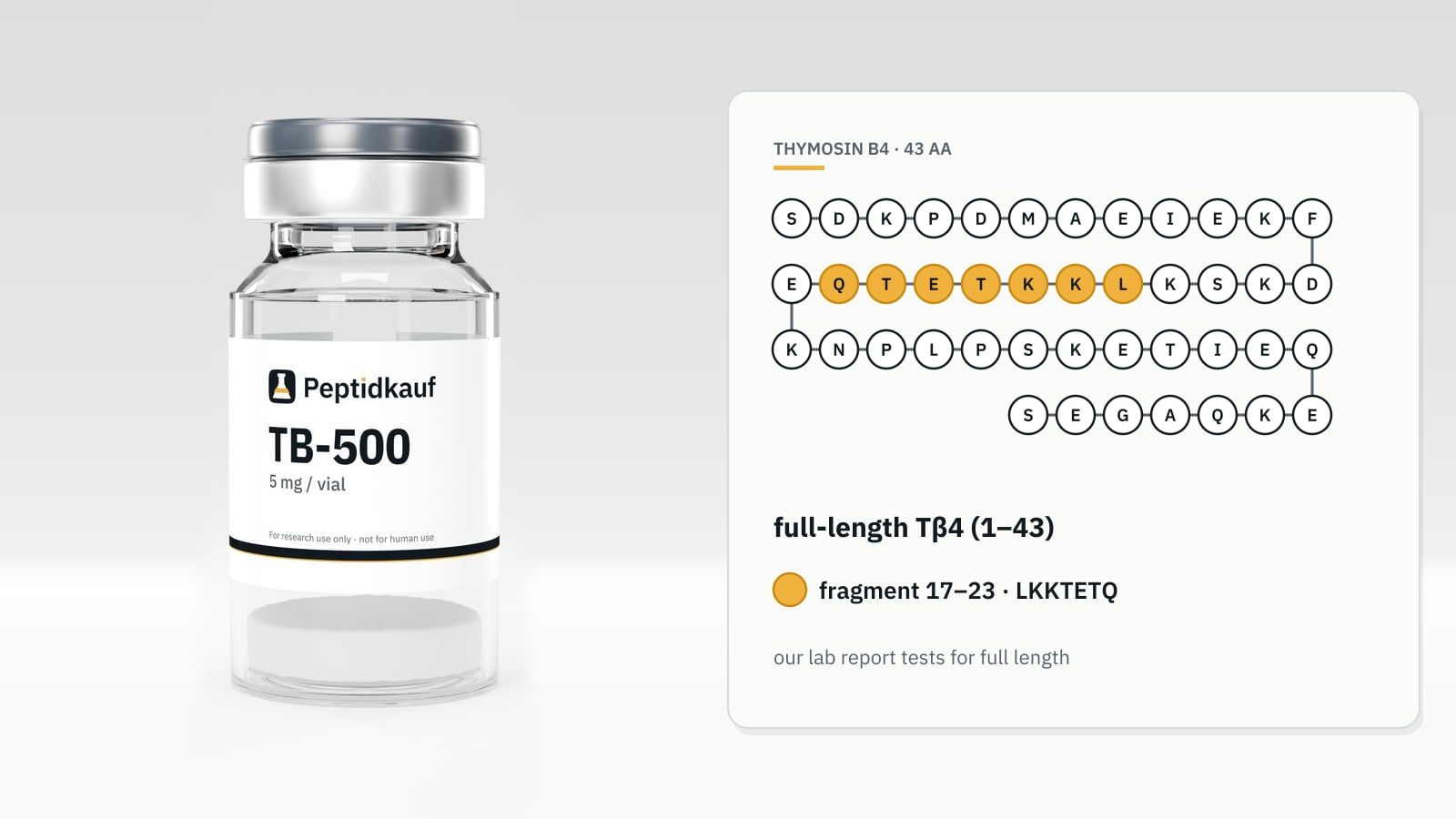
Anyone looking up TB-500 runs into a naming problem: the name means sometimes the complete protein thymosin beta-4 with 43 amino acids, sometimes a synthetic seven-amino-acid fragment. Studies of one do not automatically apply to the other. This article first clarifies what a vial labelled TB-500 can contain, then reviews the research on each molecule separately. It contains no usage or dosing advice.
At a glance
- Thymosin beta-4 (Tβ4) is an endogenous protein of 43 amino acids that binds actin.
- In the literature TB-500 usually means the fragment LKKTETQ (positions 17–23).
- In trade the name is used for both; at Peptidkauf the lab report identifies complete Tβ4.
- Almost all studies, including those in humans, concern the complete protein.
What can be in the vial
| Feature | Thymosin beta-4 | TB-500 fragment |
|---|---|---|
| Length | 43 amino acids | 7 amino acids |
| Molar mass | about 4,963 g/mol | about 890 g/mol |
| Origin | Endogenous, in almost all cells | Synthetic part of Tβ4 |
| Evidence | Many cell and animal studies, some clinical trials | Mostly analytical work |
The fivefold mass difference makes the two easy to tell apart by mass spectrometry. The independent laboratory testing our batches distinguishes TB4 from the fragment TB4(17-23) and identifies our material as complete thymosin beta-4; reports are on the TB-500 product page.
How thymosin beta-4 works
Tβ4 binds free actin building blocks and holds them in reserve, controlling how fast actin filaments grow and how mobile a cell is. The key binding section lies in the middle of the protein, the very region the fragment reproduces. Near the start lies another active section, the tetrapeptide Ac-SDKP, studied in inflammation and fibrosis research; the fragment lacks it.
What studies show
For complete Tβ4, cell and animal models describe effects on cell migration, new vessel formation and wound healing in skin, cornea and heart. Clinical trials with special preparations such as eye drops and wound gels were small or did not consistently meet their goals; there is no approved Tβ4 medicine. For the fragment, most papers since its identification by a Ghent anti-doping laboratory in 2012 describe detection methods; its own effects are barely tested.
Why is TB-500 banned in sport?
Thymosin beta-4 and its derivatives, including TB-500, are on the World Anti-Doping Agency's prohibited list among growth factors, because of their potential to influence regeneration and tissue remodelling.
TB-500 and BPC-157
Tβ4 acts via actin and cell migration, BPC-157 mainly via vessel formation; see BPC-157 vs. TB-500. Both are available together in the BPC-157 + TB-500 blend.
Frequently asked questions
Is TB-500 the same as thymosin beta-4?
Not in the literature, where TB-500 means a seven-amino-acid fragment. In trade the name is also used for the complete protein; at Peptidkauf it is complete Tβ4 according to the lab report.
Are there human studies?
Some small clinical trials with Tβ4 preparations; none with the fragment.
Is TB-500 approved?
No. Neither Tβ4 nor the fragment is approved as a medicine in the EU.
Conclusion
With TB-500, the content of the vial decides everything else. Measure identity first, and compare studies only with the molecule they actually examined.