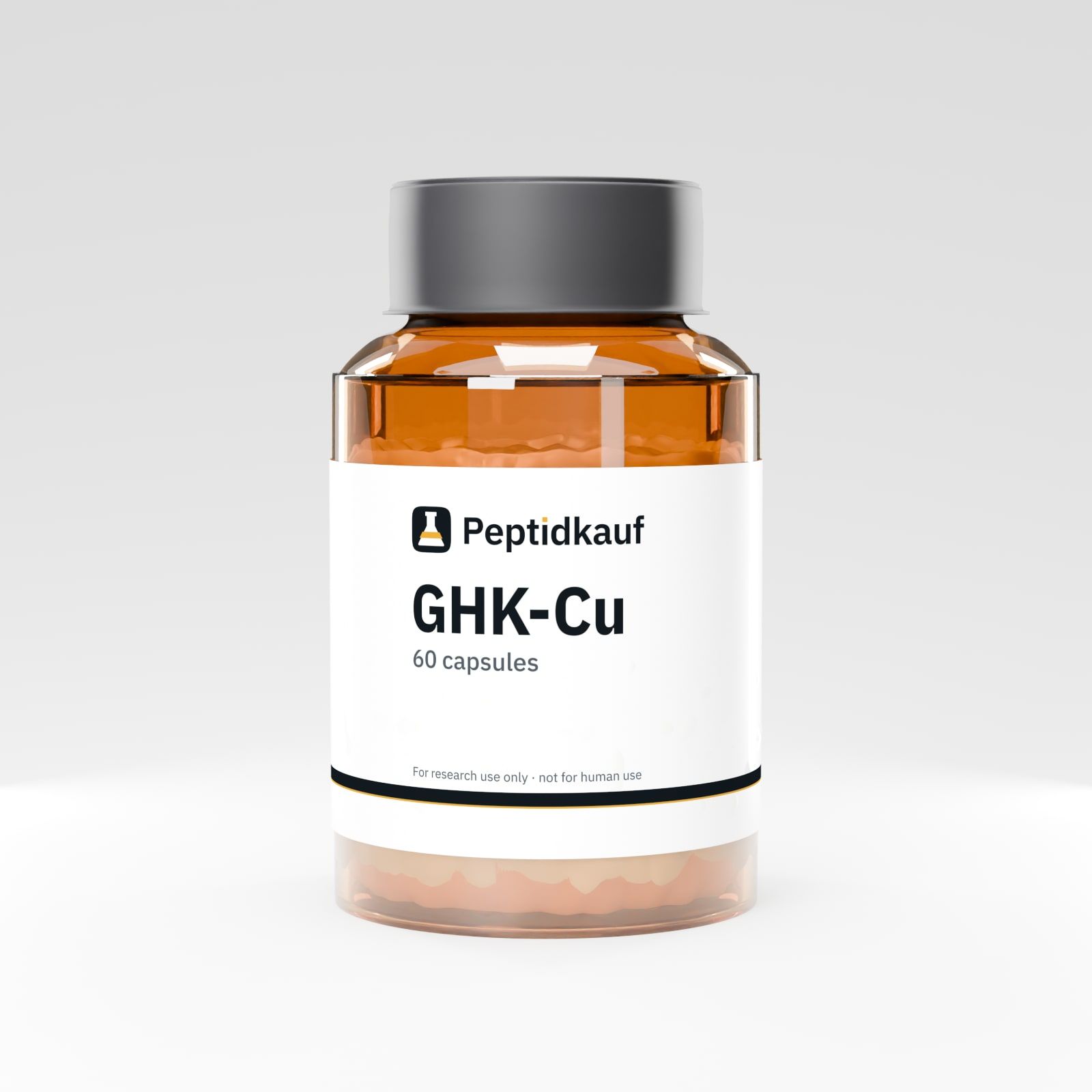



What is GHK-Cu Capsules?
GHK is the tripeptide Gly-His-Lys, which binds divalent copper with high affinity. It occurs in human plasma, saliva and urine, and plasma levels decline with age. Lab reports therefore often state three values: total GHK-Cu, the GHK fraction and the copper content. In capsule form the substance comes in a constant amount per capsule, which makes standardised test series without reconstitution easier.
More data in the lexicon entry on GHK-Cu.
State of research
GHK was discovered in human blood plasma in 1973 by Loren Pickart. As a copper complex it stimulates collagen and glycosaminoglycan production in fibroblasts; gene expression analyses show effects on hundreds of tissue repair genes. Clinical data come mainly from cream studies in which copper peptides were tested as anti-ageing ingredients.
The oral form has hardly been studied. Whether the copper complex survives digestion and whether GHK is absorbed intact are open questions. Capsules contain a fixed amount each and need no reconstitution. In research they suit experiments on stability, release and degradation in simulated digestion. The evidence on skin, hair and wound healing is described in GHK-Cu in research.
Status and quality
GHK-Cu is widely used as a cosmetic ingredient but is not approved as a medicine. Peptidkauf sells GHK-Cu Capsules solely as a research reagent for laboratory and in-vitro use and gives no dosing or application advice.
An independent laboratory tests every batch for identity and content before it goes on sale; the reports and their verification keys are in the lab report archive. Store the capsules dry, protected from light and at room temperature; no reconstitution is needed.
Related products and articles
GHK-Cu lyophilised: GHK-Cu. The related copper peptide: AHK-Cu, comparison GHK-Cu vs. AHK-Cu. More in the skin and copper peptides research area.