


What is B7-33?
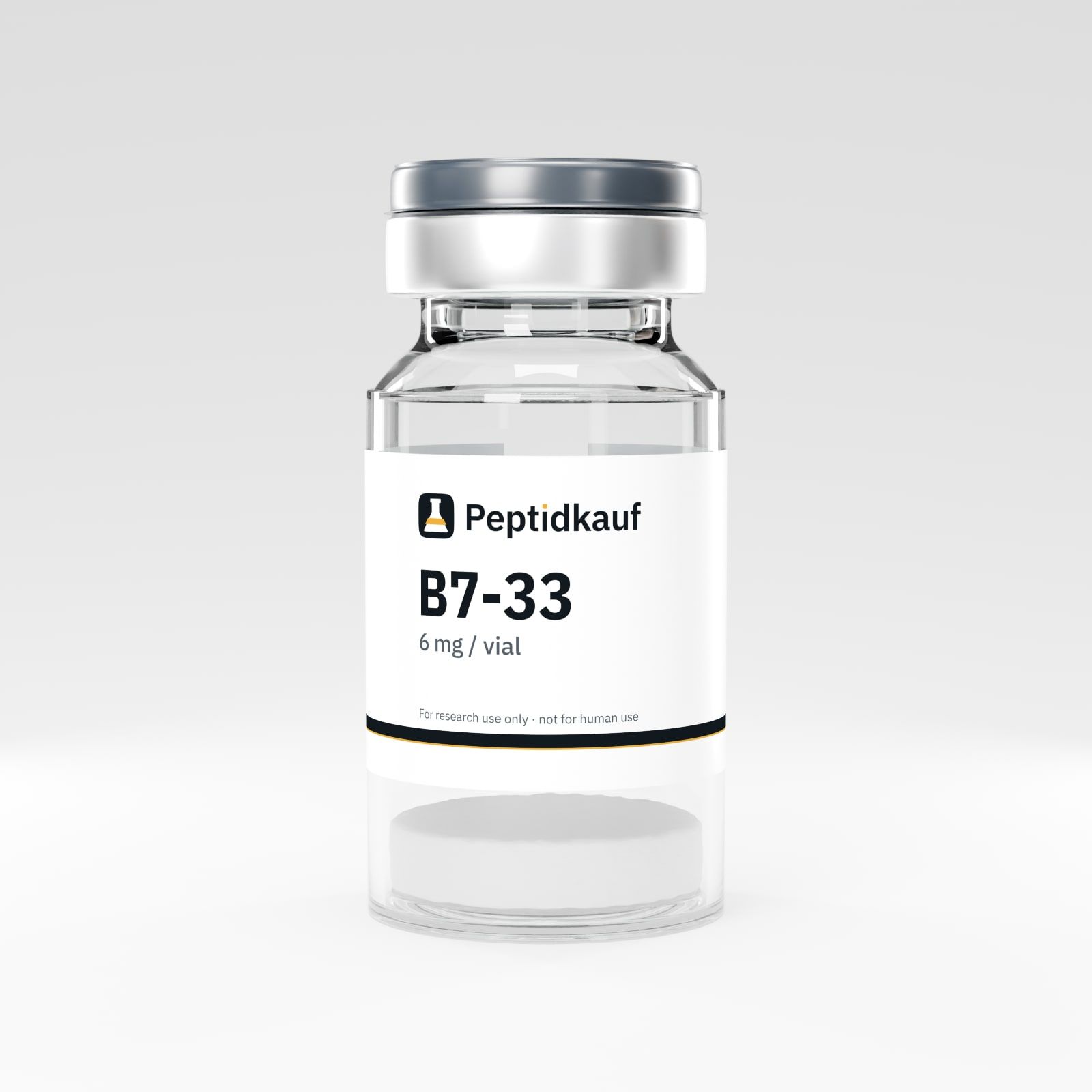
B7-33 comprises amino acids 7–33 of the relaxin-2 B-chain with substitutions that improve solubility. Unlike native relaxin it needs no A-chain.
More data in the lexicon entry on B7-33.
State of research
Native relaxin consists of two chains linked by disulfide bridges and is laborious to make. A group at the Florey Institute in Melbourne developed B7-33 as a simpler mimetic (Hossain et al., Nature Chemical Biology 2016).
Its biased signalling stands out: at RXFP1, B7-33 preferentially activates the ERK pathway, which is linked to anti-fibrotic effects, and hardly the cAMP pathway. In mouse models it reduced scarring in lung, heart and kidney. There are no human data.
Status and quality
B7-33 is not approved as a medicine. Peptidkauf sells B7-33 solely as a research reagent for laboratory and in-vitro use and gives no dosing or application advice.
An independent laboratory tests every batch for purity (HPLC), identity and measured content before it goes on sale; the reports and their verification keys are in the lab report archive. The material ships as lyophilised powder in a glass vial; storage and laboratory handling are covered under storage & handling.
Related products and articles
More tissue research peptides: TP508, BPC-157, thymosin alpha-1. Overview in the regeneration research area.