Epitalon and telomeres: taking stock of the research
Peptidkauf Redaktion3 min read
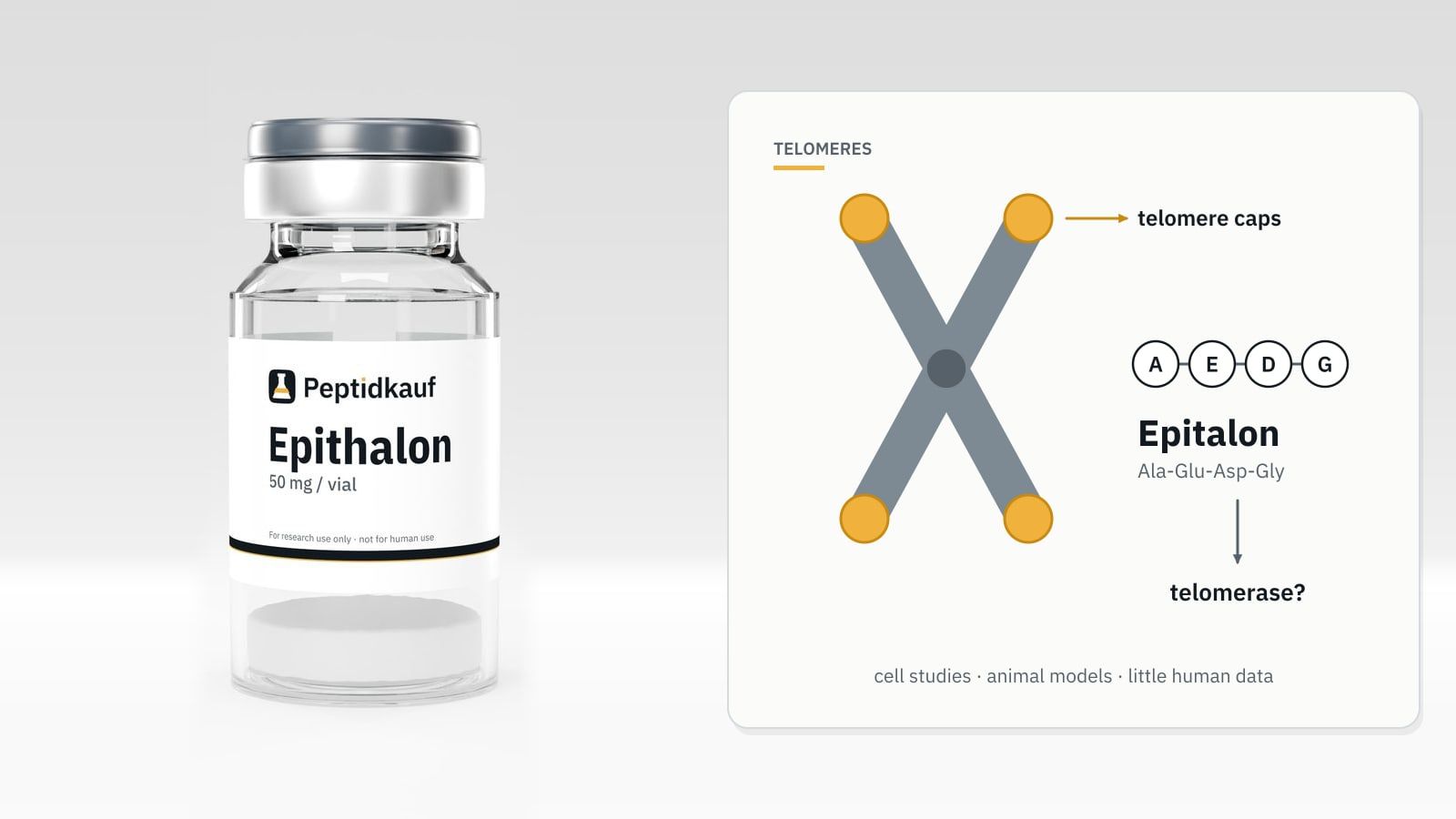
Epitalon is a textbook example of a large story built on few studies. The four-amino-acid peptide is said to lengthen telomeres, the protective caps of our chromosomes, and slow ageing. This article places every claim next to the kind of data behind it, so you can see what is well supported, what is plausible and what is hope. It contains no usage or dosing advice.
At a glance
- Epitalon (also epithalon) is the tetrapeptide Ala-Glu-Asp-Gly (AEDG), developed in St Petersburg.
- Cell studies report telomerase activation; an independent study confirmed this in normal human cells in 2025.
- Animal studies on lifespan and tumours are inconsistent.
- Good controlled studies with the pure peptide in humans are missing.
Claim and evidence
| Claim | Basis | Assessment |
|---|---|---|
| Epitalon activates telomerase | Cell cultures; independently confirmed 2025 | Well supported in cell culture |
| Epitalon lengthens telomeres | Cell cultures | Shown in culture, not in the body |
| Epitalon extends life | Animal studies from one group | Inconsistent, not independently confirmed |
| Epitalon rejuvenates people | No controlled studies | Not supported |
From extract to peptide
The starting point was epithalamin, a bovine pineal extract studied from the 1980s by Vladimir Khavinson's group at the St Petersburg Institute of Bioregulation and Gerontology. The group later designed a synthetic tetrapeptide after the extract's amino acid composition. Much of the human data concerns the extract, not the pure peptide.
The cell studies
Early work from the Khavinson group reported that epitalon switches on telomerase in human fibroblasts, lengthens telomeres and increases possible cell divisions. In 2025 an independent study confirmed concentration-dependent telomerase activation and telomere lengthening in normal human cells, and found the alternative lengthening pathway used by some cancer cells (ALT) to be little active. This is the most important confirmation so far, but it remains limited to cell culture.
The animal studies and humans
Rodent studies of lifespan, tumours and hormone rhythms gave mixed results, nearly all from the same group. Human data are mainly observational studies with the extract, published in Russian journals; controlled studies with pure epitalon are missing.
A disputed mechanism
The Khavinson group proposes that very short peptides bind specific DNA regions and regulate genes. The idea is disputed and barely tested independently; it applies to other bioregulators such as pinealon and vesugen too.
In the lab
For telomere work the cell model is decisive: normal cells and cancer lines behave fundamentally differently. Telomerase activity is usually measured by TRAP assay, telomere length by PCR or fragment analysis, always with untreated cells and a scrambled control peptide. Epitalon and the more stable N-acetyl epitalon amidate are available with a report for every batch.
Frequently asked questions
Is epithalon the same as epitalon?
Yes, both spellings refer to the tetrapeptide AEDG.
Does epitalon lengthen telomeres?
In cell culture yes, independently confirmed in 2025; not shown in the living organism or in humans.
Is telomerase activation harmless?
That is open: telomerase is also active in most cancer cells, so research treats the topic cautiously.
Conclusion
Epitalon has a genuine scientific basis in cell culture. Everything beyond, from longer life to rejuvenation, rests on inconsistent animal data or on hope.