Melanotan 2, melanotan 1 and PT-141: the melanocortin peptides explained
Peptidkauf Redaktion4 min read
Melanotan 2 is one of the most searched peptides of all, usually under terms like "tanning". Scientifically it belongs to a larger family: the melanocortin peptides, which also include melanotan 1 (afamelanotide) and PT-141 (bremelanotide). Two of them are approved as medicines, one is not, and that one is most often sold outside any control. This article explains how the three peptides work, how they differ and which risks are known. It describes research and contains no usage or dosing advice.
At a glance
- All three mimic α-MSH, a hormone that acts at five melanocortin receptors (MC1R to MC5R).
- Melanotan 1 acts mainly at MC1R (pigment cells) and is approved as afamelanotide for a rare light disorder.
- Melanotan 2 activates several receptors at once and is approved nowhere; regulators warn against products sold freely.
- PT-141 was derived from melanotan 2 and is approved in the US as bremelanotide.
The melanocortin system
α-MSH (melanocyte-stimulating hormone) is a 13-amino-acid peptide made from the precursor protein POMC, like ACTH. It acts through five receptors with very different tasks:
| Receptor | Where it occurs | Role |
|---|---|---|
| MC1R | Pigment cells of the skin | Dark eumelanin production, UV protection |
| MC2R | Adrenal gland | Cortisol production (ACTH only) |
| MC3R, MC4R | Brain | Appetite, energy balance, sexual behaviour |
| MC5R | Glands, immune cells | Sebaceous glands, inflammation |
Depending on which receptors a peptide hits, the effects differ completely. That is exactly what distinguishes the three compounds.
Melanotan 1 (afamelanotide)
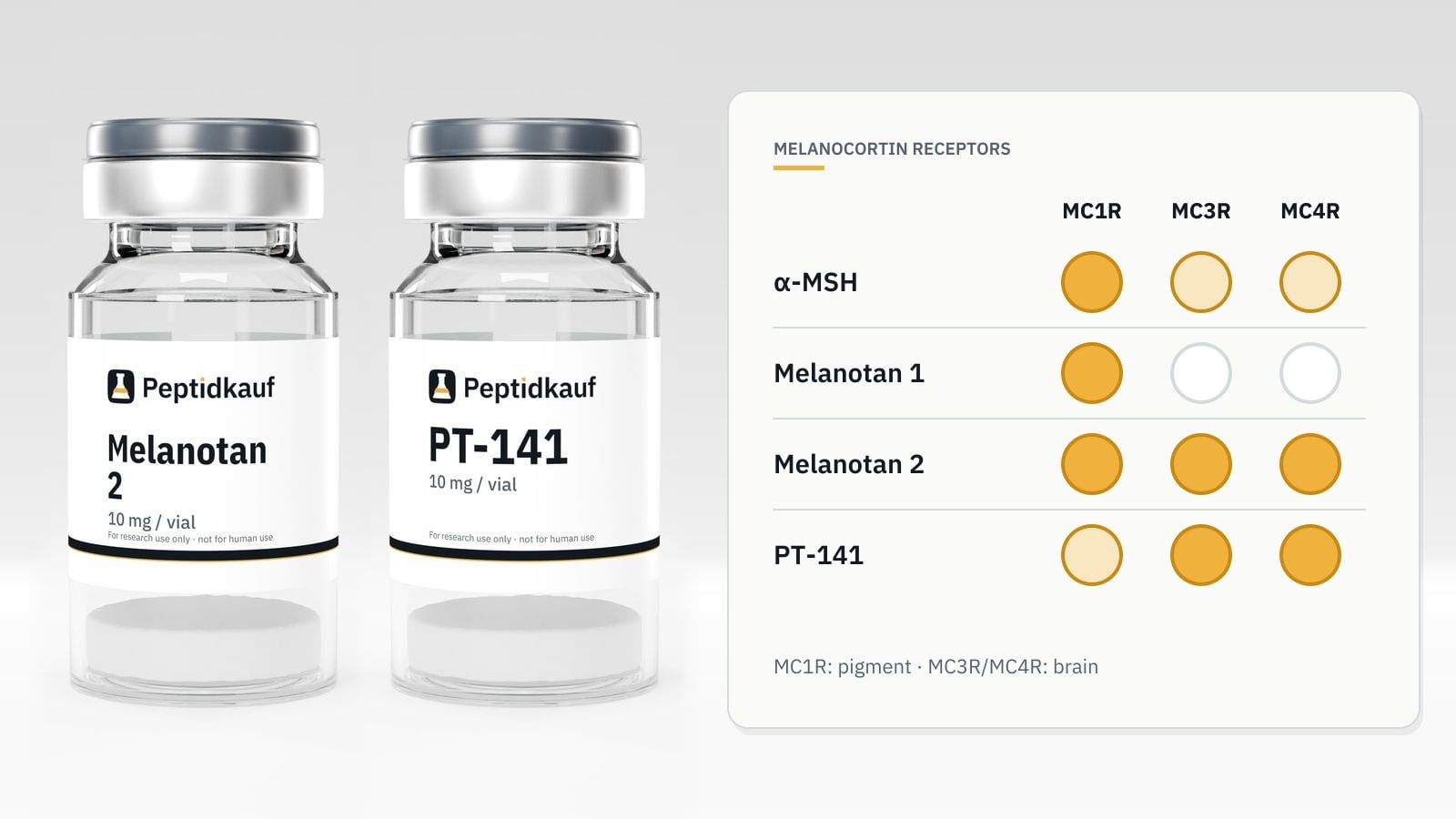
Melanotan 1 was developed at the University of Arizona in the 1980s. Two substitutions relative to α-MSH make it stable and much more potent. It acts largely selectively at MC1R, where it stimulates eumelanin production.
As afamelanotide it was tested in erythropoietic protoporphyria, a rare disease with painful light sensitivity. Since 2014 it has been approved for this in the EU as an implant, used under medical supervision in specialist centres. More on the molecule on the product page melanotan 1.
Melanotan 2
Melanotan 2 is a short, cyclic peptide of seven building blocks developed by the same group. The ring makes it very stable but barely selective: it activates MC1R, MC3R, MC4R and MC5R. Early studies therefore observed nausea, facial flushing, loss of appetite and spontaneous erections alongside pigmentation.
Melanotan 2 was never approved as a medicine. Even so, it has been sold online as a "tanning agent" for years. Medicines regulators in several European countries, including Germany, have warned against such products because quality and content are unknown and risks have not been studied.
Known risks
- Nausea, vomiting, facial flushing are the most commonly reported effects.
- Moles: case reports describe new or changing moles and occasional melanomas. Whether there is a causal link is unclear.
- Circulation: rises in blood pressure have been described.
- Unknown product quality: freely sold products have been found to contain wrong amounts or impurities.
In research, melanotan 2 is a tool for studying several melanocortin receptors at once. More on the product page melanotan 2.
PT-141 (bremelanotide)
PT-141 was derived directly from melanotan 2: it is the variant with a free acid at the end. Its developers were interested in the effect on sexual behaviour, mediated by MC3R and MC4R in the brain, rather than in pigmentation.
As bremelanotide, PT-141 has been approved in the US since 2019 for a narrow indication: low sexual desire in premenopausal women. It is not approved in the EU. In the registration trials nausea, flushing and a transient rise in blood pressure were the most common side effects. More on the product page PT-141.
The three compared
| Peptide | Receptors | Status |
|---|---|---|
| Melanotan 1 (afamelanotide) | Mainly MC1R | EU approval for a rare light disorder |
| Melanotan 2 | MC1R, MC3R, MC4R, MC5R | Not approved anywhere; regulator warnings |
| PT-141 (bremelanotide) | Mainly MC3R, MC4R | US approval for a narrow indication |
Melanocortin peptides in the lab
In research the three peptides are tools for clarifying the role of individual receptors: melanotan 1 for MC1R and pigmentation, PT-141 for the central receptors, melanotan 2 as a broad agonist. Because the peptides have similar masses, identity testing by mass spectrometry matters. Peptidkauf sells all three solely as research reagents with a lab report for every batch, not for use in humans and not as tanning agents.
Frequently asked questions
What is melanotan 2?
A synthetic cyclic peptide that activates several melanocortin receptors. It is not approved as a medicine.
What is the difference between melanotan 1 and melanotan 2?
Melanotan 1 acts mainly at MC1R and is approved as afamelanotide. Melanotan 2 acts at several receptors, including in the brain, and is not approved.
Is PT-141 the same as melanotan 2?
No, but closely related. PT-141 is a variant of melanotan 2 studied mainly at receptors in the brain.
Is melanotan legal in the EU?
Melanotan 2 is not an approved medicine; regulators warn against freely sold products. As a research reagent it is intended for laboratory experiments.
Conclusion
Melanotan 1, melanotan 2 and PT-141 show how strongly a peptide's effect depends on which receptors it hits. Two of them reached approval for clearly defined indications. Melanotan 2, by contrast, is a research tool with known risks, and regulators rightly view its freely sold products critically.