Ipamorelin: effects, selectivity and the evidence
Peptidkauf Redaktion3 min read
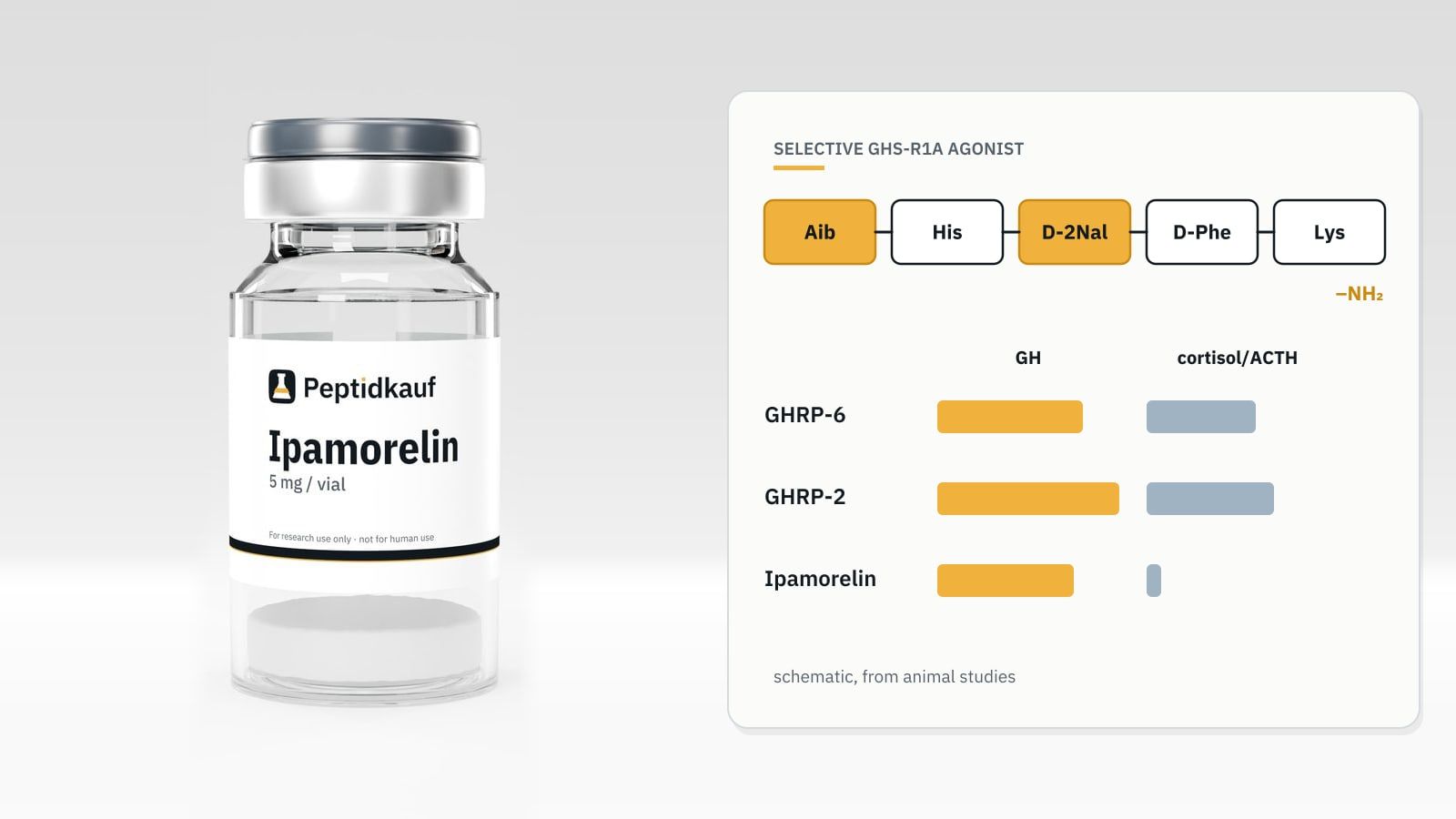
Ipamorelin is considered the "cleanest" of the ghrelin mimetics: it releases growth hormone without notably raising the stress hormones cortisol and ACTH in animal studies. This selectivity has made it one of the most searched research peptides, often combined with CJC-1295. This article explains how ipamorelin is built, how it works, what the studies show and why it was never approved. It describes research and contains no usage or dosing advice.
At a glance
- Ipamorelin is a pentapeptide (Aib-His-D-2Nal-D-Phe-Lys-NH₂) developed at Novo Nordisk in the late 1990s.
- It activates the ghrelin receptor GHS-R1a and releases growth hormone.
- Unlike GHRP-6 and GHRP-2, it hardly raised cortisol and ACTH in animal studies.
- A phase 2 trial in postoperative ileus missed its goal; ipamorelin is not approved.
What is ipamorelin?
Ipamorelin belongs to the growth hormone-releasing peptides (GHRPs), short synthetic peptides that act at the ghrelin receptor. Its sequence contains two unusual building blocks: Aib (aminoisobutyric acid) at the start and D-2-naphthylalanine, an artificial amino acid. Both make the peptide more stable and shape how it binds the receptor.
The first description (Raun et al., European Journal of Endocrinology 1998) called ipamorelin the first selective growth hormone secretagogue.
How does ipamorelin work?
The ghrelin receptor GHS-R1a sits, among other places, on the hormone-producing cells of the pituitary. When activated, they release growth hormone. Ghrelin itself, the "hunger hormone" from the stomach, uses the same receptor.
Why selectivity matters
Older GHRPs such as GHRP-6 and GHRP-2 release cortisol, ACTH and prolactin as well as growth hormone; GHRP-6 also markedly increases appetite. In the ipamorelin animal studies, cortisol and ACTH hardly rose even at high amounts. For research this means effects can be attributed to the GH axis without a stress response clouding the results.
| Peptide | Growth hormone | Cortisol/ACTH | Appetite |
|---|---|---|---|
| GHRP-6 | strong | raised | markedly raised |
| GHRP-2 | very strong | raised | raised |
| Hexarelin | very strong, rapid tolerance | raised | little |
| Ipamorelin | clear | barely changed | little |
What do the studies show?
Animal models
Besides the selectivity studies, work examined effects on bone growth, body composition and glucocorticoid-induced muscle loss in rodents. The findings fit sustained stimulation of the GH axis.
In humans
Pharmacological studies in healthy volunteers described dose-dependent GH release and a short half-life of around two hours. Because ghrelin receptors also occur in the gut, ipamorelin was tested in a phase 2 trial for bowel paralysis after abdominal surgery. The trial missed its primary endpoint, and development was stopped.
Why ipamorelin is combined with CJC-1295
Growth hormone is controlled through two receptors: the GHRH receptor and the ghrelin receptor. Physiological studies showed that activating both together releases more growth hormone than the sum of each alone. This is the basis for combining it with a GHRH analogue such as CJC-1295 no DAC. There are no controlled studies of this exact combination. A direct comparison is in CJC-1295 vs. ipamorelin; the whole class is covered in ipamorelin, CJC-1295, tesamorelin & co..
Side effects and status
Human safety data are limited. As far as known, effects match those of raised GH levels; the rises in cortisol and appetite typical of older GHRPs were described less often. Ipamorelin is not approved as a medicine and is on the WADA Prohibited List as a growth hormone-releasing factor.
Ipamorelin in the lab
In cell and animal models ipamorelin is the tool of choice for selective ghrelin receptor activation. Peptidkauf offers ipamorelin and the blends CJC-1295 no DAC + ipamorelin and tesamorelin + ipamorelin as research reagents with a lab report for every batch.
Frequently asked questions
What is ipamorelin?
A synthetic pentapeptide that acts at the ghrelin receptor and stimulates growth hormone release.
Why is ipamorelin considered selective?
Because in animal studies it released growth hormone without markedly raising cortisol and ACTH, unlike GHRP-6 and GHRP-2.
Is ipamorelin approved?
No. A phase 2 trial missed its goal, and clinical development was stopped.
What is the difference between ipamorelin and CJC-1295?
Ipamorelin acts at the ghrelin receptor, CJC-1295 at the GHRH receptor. Both release growth hormone, through different routes.
Conclusion
Ipamorelin is the most selective of the classic ghrelin mimetics and therefore a precise tool for growth hormone axis research. It did not succeed clinically, and human data are limited. For laboratory work its clean pharmacology is what counts.