Ipamorelin, CJC-1295, tesamorelin & co.: peptides of the growth hormone axis
Peptidkauf Redaktion4 min read
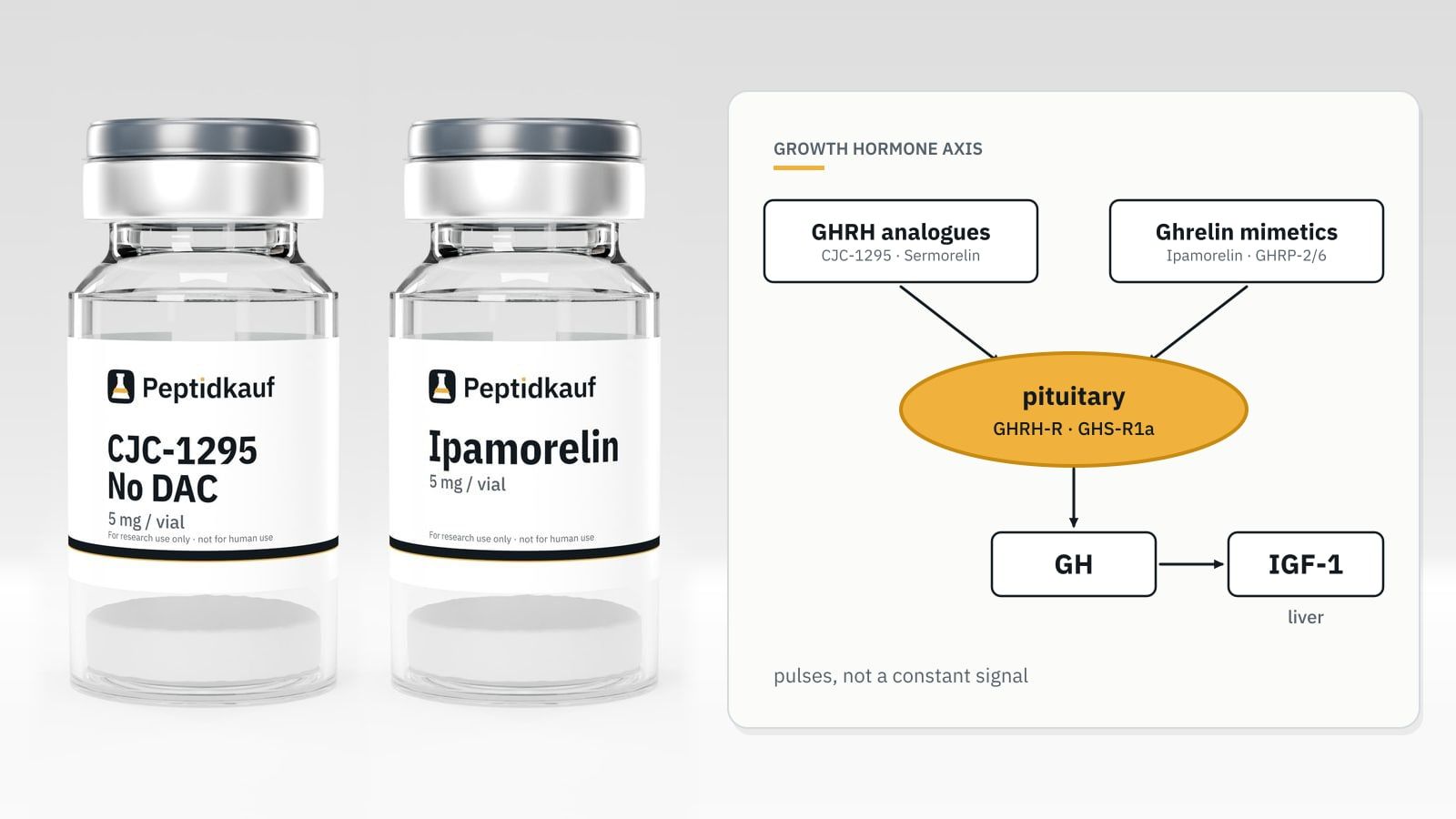
Ipamorelin, CJC-1295 and tesamorelin are among the most searched research peptides. They share one target: the pituitary gland, which releases growth hormone (GH). But they act at different points, last for very different times and have very different regulatory status. This article sorts the peptides of the growth hormone axis into two families, explains the differences and summarises what the studies actually show. It describes research and contains no usage or dosing advice.
At a glance
- There are two families: GHRH analogues (sermorelin, CJC-1295, tesamorelin) and ghrelin mimetics (GHRP-6, GHRP-2, hexarelin, ipamorelin).
- Both stimulate the pituitary to release growth hormone, through different receptors. Combined, they amplify each other.
- Ipamorelin is considered especially selective: in animal studies cortisol and ACTH hardly rose.
- Only tesamorelin is approved as a medicine (in the US, for a narrow indication). All of them are on the anti-doping prohibited list.
How the growth hormone axis works
The pituitary does not release growth hormone evenly but in pulses, mostly at night. Three signals control this:
- GHRH (growth hormone-releasing hormone) from the hypothalamus stimulates release.
- Somatostatin inhibits it.
- Ghrelin, the hunger hormone from the stomach, amplifies it through its own receptor, GHS-R1a.
Growth hormone acts largely not directly but through IGF-1, made mainly by the liver. IGF-1 is therefore the key readout in studies.
Family 1: GHRH analogues
GHRH analogues mimic natural GHRH. The first 29 amino acids are enough for full activity, but they are broken down in minutes in the body.
Sermorelin
Sermorelin corresponds exactly to these 29 amino acids. It was approved in the US for a time, but marketing was discontinued. Because of its short half-life it now serves mainly as a reference substance.
CJC-1295 with and without DAC
CJC-1295 without DAC, also called Mod GRF 1-29, swaps four amino acids so that the peptide is broken down more slowly. CJC-1295 with DAC also carries a group that binds albumin in the blood. In early human studies GH and IGF-1 levels then stayed raised for days. Development as a medicine was stopped. The differences are shown in CJC-1295 DAC vs. no DAC.
Tesamorelin
Tesamorelin is full-length GHRH with 44 amino acids and a protective fatty acid group at the start. It is the best-studied peptide of this group: in phase 3 trials in people with HIV-associated lipodystrophy it reduced visceral abdominal fat compared with placebo. It is approved for this indication in the US, not in the EU.
Family 2: ghrelin mimetics (GHRPs)
The second family acts at the ghrelin receptor. Its members are called growth hormone-releasing peptides (GHRPs) or growth hormone secretagogues (GHS). They were developed from the 1980s, before ghrelin itself had been discovered.
| Peptide | Distinctive feature in studies |
|---|---|
| GHRP-6 | Strong GH release, marked increase in appetite |
| GHRP-2 | Stronger than GHRP-6, also raises cortisol and prolactin |
| Hexarelin | Very potent, but rapid tolerance (desensitisation) |
| Ipamorelin | Selective: GH release without a marked rise in cortisol and ACTH |
Ipamorelin
Ipamorelin was developed at Novo Nordisk in the late 1990s. The first description showed GH release in animal models without a notable rise in stress hormones, unlike GHRP-6 and GHRP-2. In humans it was tested in a phase 2 trial for postoperative ileus, which missed its goal. It is not approved.
Why GHRH analogues and GHRPs are combined
GHRH and ghrelin act through different receptors and amplify each other. Physiological studies in the 1990s showed that giving GHRH and a GHRP together releases more growth hormone in humans than the sum of each alone. This is the basis for blends such as CJC-1295 no DAC + ipamorelin and tesamorelin + ipamorelin. There are, however, no controlled studies of these specific combinations. A direct comparison is in CJC-1295 vs. ipamorelin.
Side effects and risks
Where human data exist, the reported side effects mainly reflect raised GH and IGF-1: water retention, joint and muscle pain, tingling in the hands and changes in glucose metabolism. With GHRP-6 and GHRP-2, increased appetite and rises in cortisol and prolactin are added. Long-term raised IGF-1 levels are linked in research to risks that are not yet fully understood.
Legal status
Except for tesamorelin in the US, none of these peptides is approved as a medicine. All are on the World Anti-Doping Agency's prohibited list as growth hormone-releasing factors. As research reagents they are intended for laboratory experiments, not for use in humans.
Frequently asked questions
What is the difference between ipamorelin and CJC-1295?
Ipamorelin acts at the ghrelin receptor, CJC-1295 at the GHRH receptor. Both stimulate growth hormone release, through different routes.
Is tesamorelin approved?
In the US, yes, for reducing abdominal fat in HIV-associated lipodystrophy. Not in the EU.
Why is ipamorelin considered selective?
Because in animal studies it released growth hormone without markedly raising cortisol and ACTH, unlike older GHRPs.
What does DAC mean in CJC-1295?
Drug Affinity Complex: a chemical group that binds albumin and extends the duration of action from minutes to days.
Is MK-677 a peptide as well?
No. MK-677 (ibutamoren) also acts at the ghrelin receptor but is a small molecule, not a peptide.
Conclusion
The peptides of the growth hormone axis are easy to sort: GHRH analogues such as sermorelin, CJC-1295 and tesamorelin mimic the releasing hormone; ghrelin mimetics such as GHRP-6 and ipamorelin act through the ghrelin receptor. In humans, tesamorelin is by far the best studied; for the others, knowledge rests mostly on older studies and animal models. For research they are valuable tools for understanding the pulsatile control of growth hormone.