BPC-157: what the studies show and where they stop
Peptidkauf Redaktion4 min read
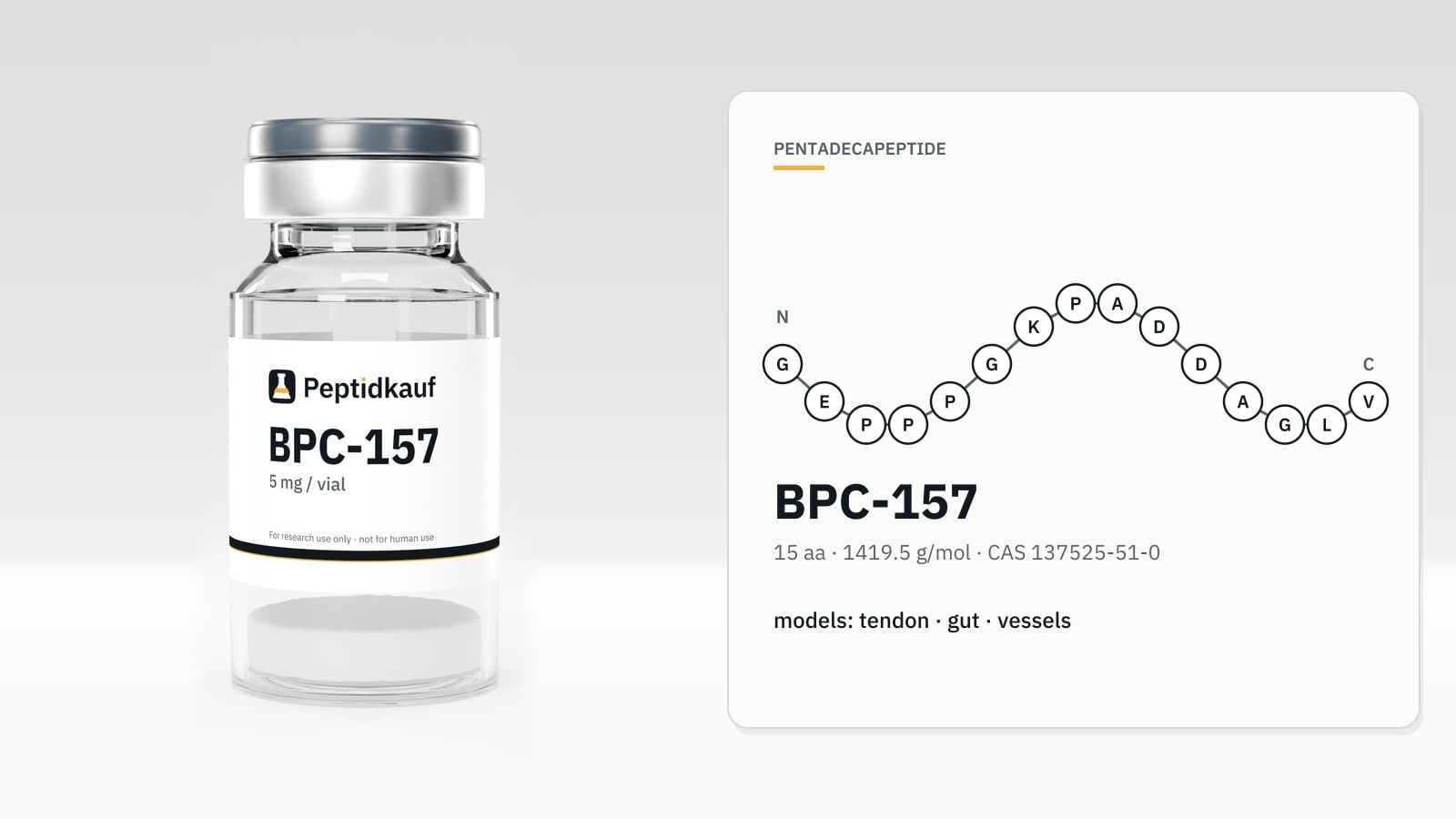
Few research peptides are searched for as often as BPC-157, and few are researched so unevenly. Hundreds of animal studies stand against almost no controlled studies in humans. Understanding what is known therefore starts with sorting: which model, which group, which endpoint? This article orders the evidence by level, explains the proposed mechanisms and shows what is and is not known about side effects. It contains no usage or dosing advice.
At a glance
- BPC-157 is a 15-amino-acid peptide (GEPPPGKPADDAGLV) derived from a protein in gastric juice.
- Most data come from rat and mouse models, much of it from a single group in Zagreb.
- Studies focus on tendons, ligaments, the gastrointestinal lining and blood vessels.
- Controlled human studies are missing; reliable statements about effects or side effects in humans are not possible.
The evidence in four levels
| Level | Data on BPC-157 | What it tells us |
|---|---|---|
| Cell culture | Several studies, e.g. endothelial cells and fibroblasts | Possible mechanisms, not effects in an organism |
| Animal models | Several hundred papers, mostly rats | Effects under laboratory conditions, often shown by one group only |
| Observations in humans | Isolated case series, small pilot work | Signals without a control group |
| Controlled clinical trials | No completed, published efficacy trials | Needed for human claims, but absent |
What animal models examined
Tendons and ligaments. In rat models of cut or damaged tendons and ligaments, several studies reported faster recovery of structure and load capacity; tendon fibroblast cultures showed better migration and more growth factor receptors.
Stomach and gut. The name points to the origin in gastric juice. Many studies examine damage to the mucosa, for example from alcohol or anti-inflammatory painkillers, and models of inflammatory bowel disease. Unusually for a peptide, BPC-157 is relatively stable in gastric juice.
Blood vessels. Several studies describe increased formation of new blood vessels in injured tissue, often used to explain the other findings.
Proposed mechanisms
Two pathways are discussed: activation of VEGFR2, the receptor of the vessel growth factor VEGF, and interactions with the nitric oxide system that regulates vessel width and blood flow. Both explanations come largely from the same group, and no dedicated receptor for BPC-157 has been identified.
Why the evidence needs careful reading
One source dominates. Most of the literature comes from Predrag Sikirić's group at the University of Zagreb. That does not make it wrong, but independent replication is the basis of any robust claim, and there is little of it.
Animal models translate poorly. Many substances that protect tendons or gut lining in rats fail in humans; dose, route and healing course differ greatly.
Uncertain identity in the market. Studies use defined material. Whether products from the internet contain BPC-157 in the stated amount cannot be known without analysis.
What is known about side effects?
Too little. Animal studies reported few adverse effects, but they are not designed to detect rare or long-term effects in humans, and systematic human safety data are missing. Reviews discuss a theoretical concern: if BPC-157 promotes vessel formation, this could be undesirable where new vessels are unwanted, such as existing tumours. This is neither proven nor disproven.
BPC-157 and TB-500
Both are studied in regeneration research but act differently: BPC-157 via vessels and NO, thymosin beta-4 via actin binding and cell migration. There are no studies of the combination. See BPC-157 vs. TB-500.
Legal status
BPC-157 is not approved as a medicine in the EU or the US and has been on the World Anti-Doping Agency's prohibited list since 2022. See are peptides legal?.
Recognising good research material
A meaningful lab report states the batch number, HPLC purity and measured amount, and can be verified at the laboratory. At Peptidkauf the independent report for every batch is on the BPC-157 product page and in the lab report archive.
Frequently asked questions
What does BPC-157 do?
In animal models, faster healing of tendons, ligaments and mucosa and more vessel formation were described. Whether this applies to humans has not been studied.
Are there human studies?
Isolated case series and small pilot studies, but no completed controlled efficacy trials.
What side effects does BPC-157 have?
Systematic human safety data are missing; a theoretical risk from its vessel-forming effect is discussed.
Is BPC-157 approved?
No, neither in the EU nor in the US, and it is on the anti-doping prohibited list.
Conclusion
BPC-157 is extensively but one-sidedly researched: many animal studies, mostly from one group, hardly any human data. Its reported effects on tendons, mucosa and vessels make it an interesting research tool, not a proven active substance.