GLOW and KLOW: what is in the peptide blends
Peptidkauf Redaktion4 min read
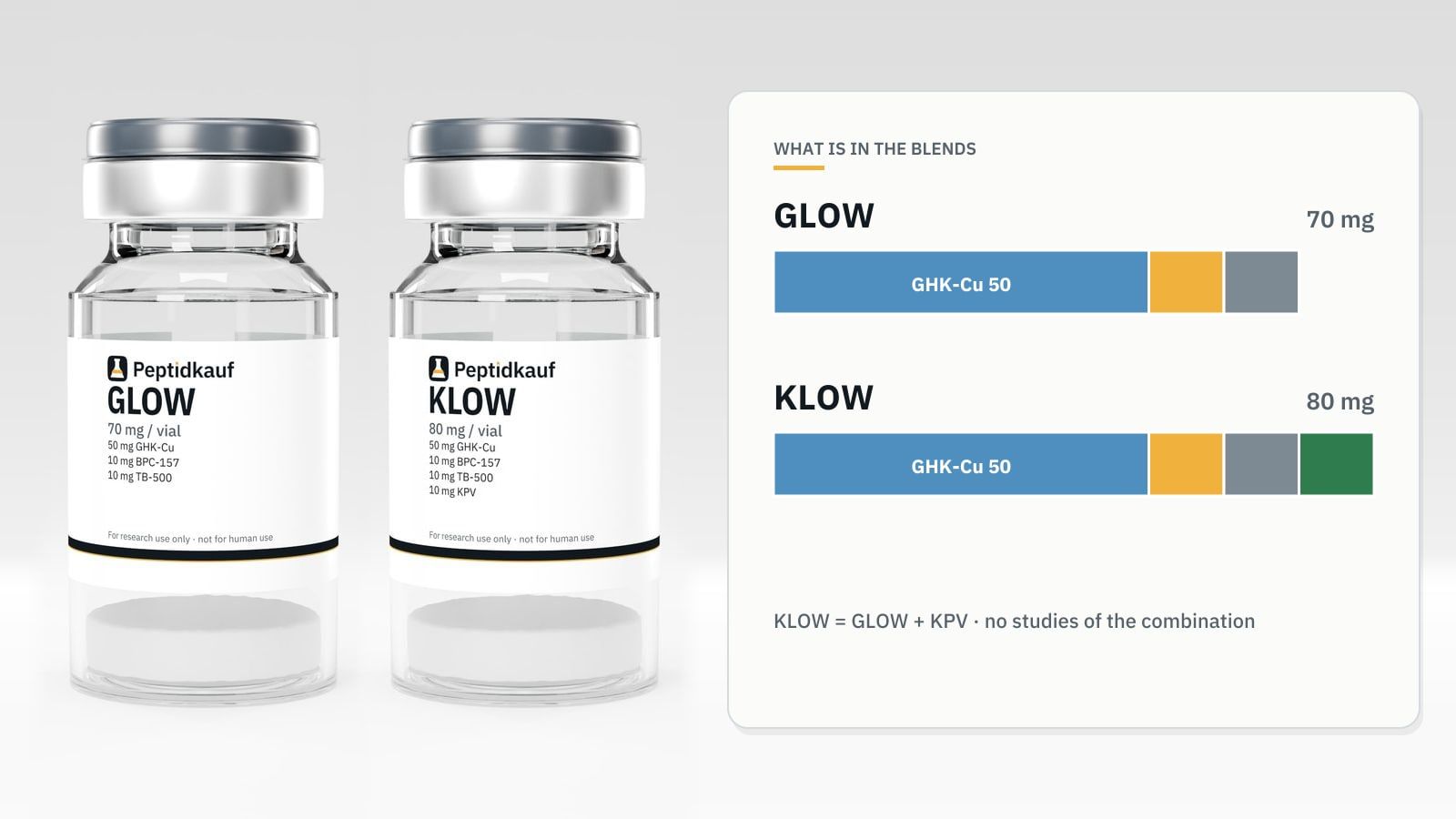
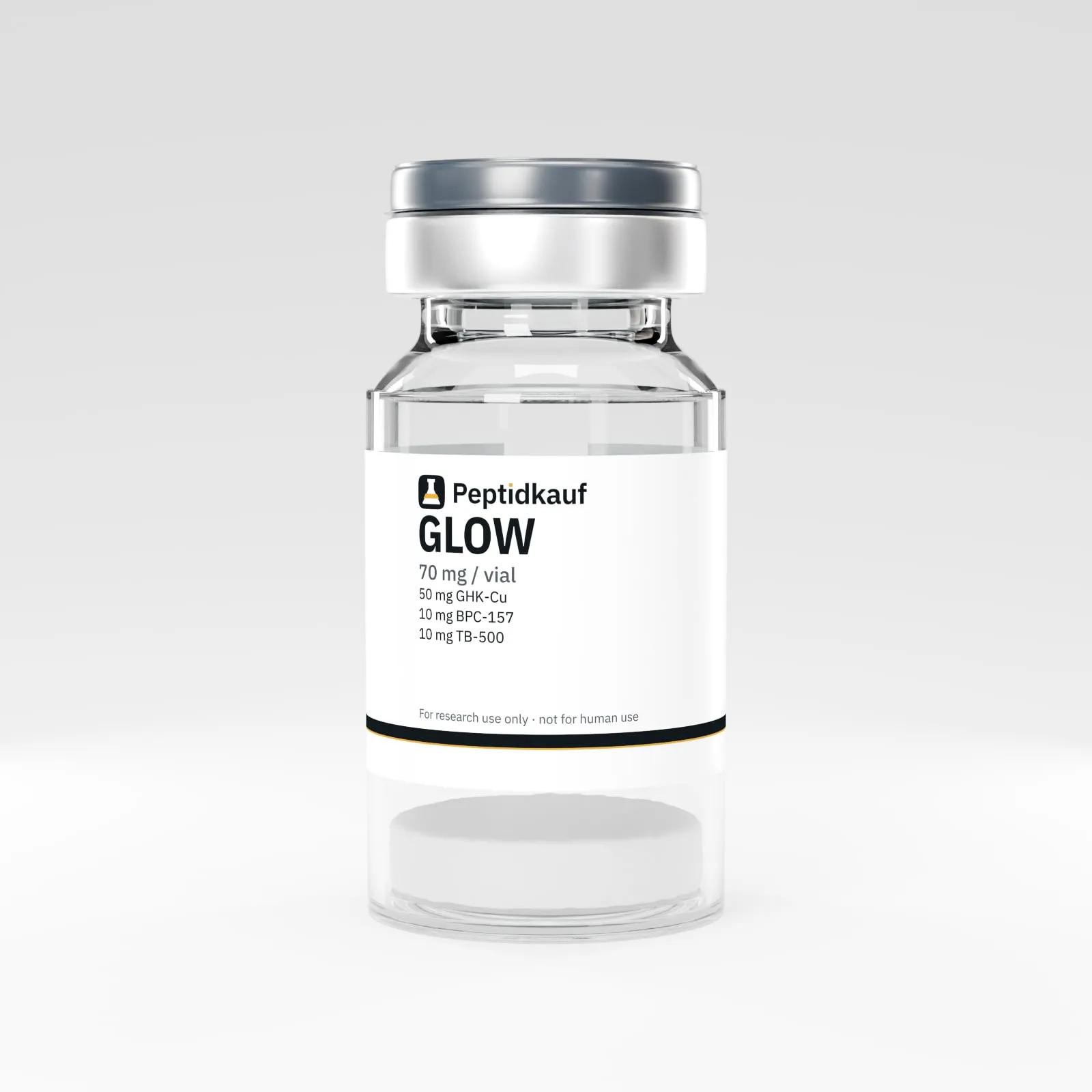
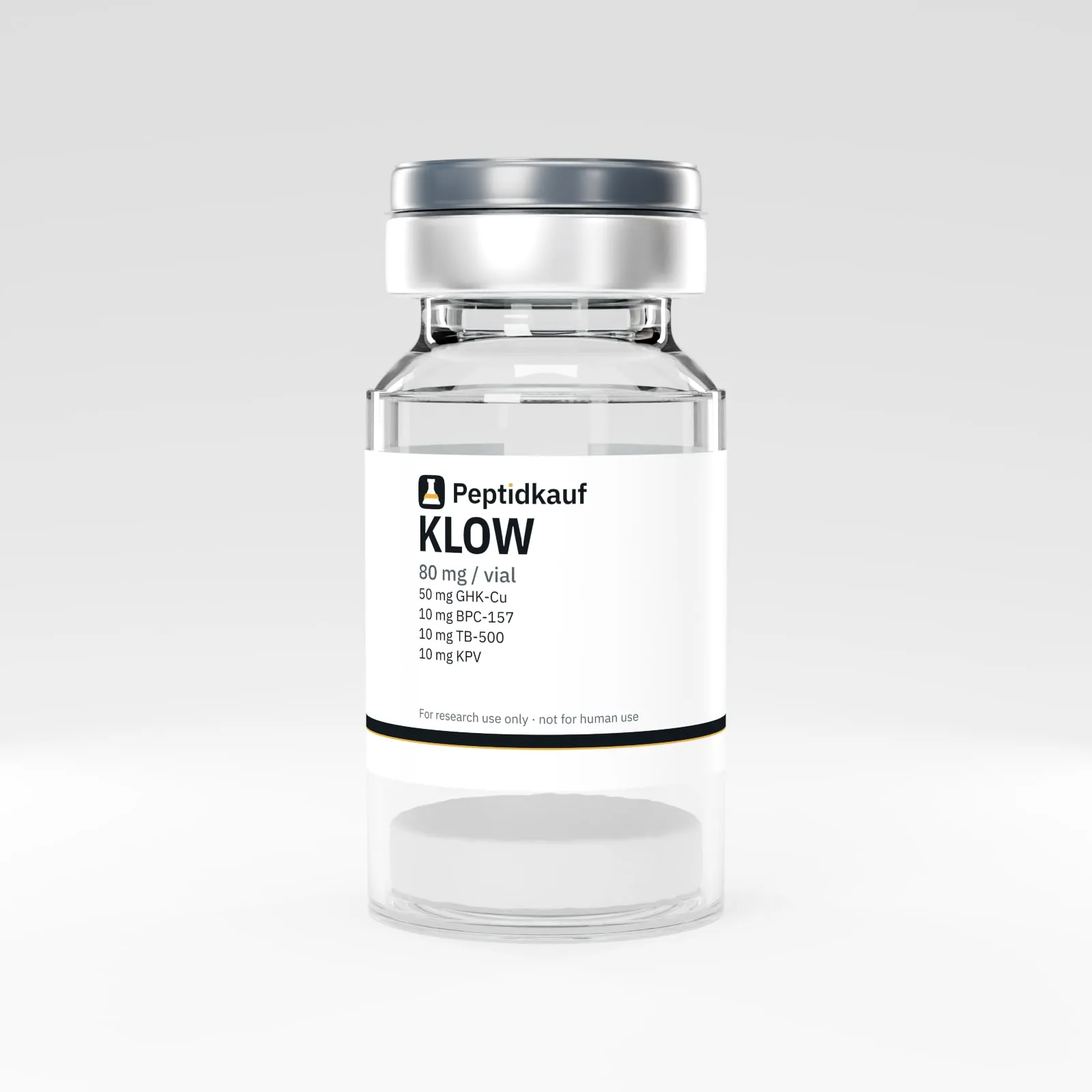
GLOW and KLOW are among the most searched peptide blends. The names stand for no new molecules but for mixtures of known research peptides in one vial: GHK-Cu, BPC-157 and TB-500, with KPV added in KLOW. This article explains exactly what is in the blends, what research shows for each component, why there are no studies of the combination itself and what matters when analysing a blend. It describes research and contains no usage or dosing advice.
At a glance
- GLOW contains GHK-Cu, BPC-157 and TB-500; KLOW adds KPV.
- The copper peptide GHK-Cu makes up the largest share by mass in both blends.
- Each component has its own, mostly preclinical literature. There are no studies of the combination.
- For a blend, a proper lab report must confirm every component separately.
What is in GLOW and KLOW?
| Component | GLOW | KLOW | Research field |
|---|---|---|---|
| GHK-Cu | 50 mg | 50 mg | Skin, collagen, wound healing |
| BPC-157 | 10 mg | 10 mg | Tendons, gut, vessels |
| TB-500 (thymosin β4) | 10 mg | 10 mg | Cell migration, wound healing |
| KPV | – | 10 mg | Inflammation |
| Total | 70 mg | 80 mg | – |
The amounts refer to the blends sold by Peptidkauf; other suppliers sometimes use different amounts. The names are trade names, not scientific terms.
The components in detail
GHK-Cu: the copper peptide
GHK-Cu is a tripeptide (Gly-His-Lys) that binds a copper ion. It occurs naturally in human blood plasma; the level falls with age. In cell culture it stimulates collagen and glycosaminoglycan production; in wound models it accelerated healing. In humans it was studied mainly in creams. More in GHK-Cu in research.
BPC-157
BPC-157 is a 15-amino-acid peptide derived from a gastric juice protein. Hundreds of animal studies examined it in tendons, ligaments, gut lining and angiogenesis, many from one group in Zagreb. Controlled human studies are lacking. More in BPC-157 in research.
TB-500 (thymosin β4)
Thymosin β4 binds the structural protein actin inside cells and so influences cell movement. In models it promoted wound healing, angiogenesis and heart tissue repair. What "TB-500" actually refers to is explained in TB-500 vs. thymosin beta-4.
KPV (KLOW only)
KPV is the tail end of the hormone α-MSH and dampens inflammation via the NF-κB pathway in cell and animal models. More in what does KPV do?.
Why there are no studies of the combination
GLOW and KLOW are market concepts. The idea: combine peptides from different research fields, skin, tissue repair, cell migration and inflammation, in one vial. Whether the components complement, amplify or interfere with each other has never been studied systematically. Claims about the effects of the blends are therefore always extrapolations from studies of the single substances.
That matters for research: anyone working with a blend cannot attribute an observed effect to one component. For questions about the contribution of individual peptides, the single substances are the better tool.
Mass is not molecule count
The milligram figures are easily misread. GHK-Cu, at about 400 g/mol, is a very small molecule; thymosin β4, at almost 5,000 g/mol, is more than ten times heavier. 10 mg of TB-500 therefore contains far fewer molecules than 10 mg of GHK-Cu. Calculating concentrations in moles gives a very different ratio from the milligram figures. The peptide calculator helps.
What matters in the analysis
A blend makes higher demands on analytics than a single peptide:
- Each component separately: in HPLC each component should have its own assigned peak, and mass spectrometry should confirm each identity.
- Amount per component: a total amount says nothing about whether the ratio is right.
- Copper content: for GHK-Cu, the bound copper fraction is part of a full characterisation.
How to read a lab report is explained in peptide purity: HPLC, MS and the COA.
GLOW and KLOW at Peptidkauf
Peptidkauf offers GLOW and KLOW as lyophilised blends and KLOW capsules, each as a research reagent with a lab report for every batch. The single substances GHK-Cu, BPC-157, TB-500 and KPV are also available.
Frequently asked questions
What is the GLOW peptide?
A blend of three research peptides: GHK-Cu, BPC-157 and TB-500 in one vial.
What is the difference between GLOW and KLOW?
KLOW also contains the anti-inflammatory tripeptide KPV.
Are there studies on GLOW or KLOW?
No. There are only studies of the individual components, mostly from cell and animal models.
Why is GHK-Cu the largest share?
The blends use GHK-Cu in the highest amount. Because it is a very small molecule, the gap is even larger in molecule numbers than in milligrams.
Conclusion
GLOW and KLOW bundle four well-studied research peptides but have not been studied themselves. Anyone working with them should know the evidence for each component, think in moles rather than only in milligrams and insist on a lab report that confirms each component separately.