Tesamorelin: effects, studies and approval of the GHRH analogue
Peptidkauf Redaktion4 min read
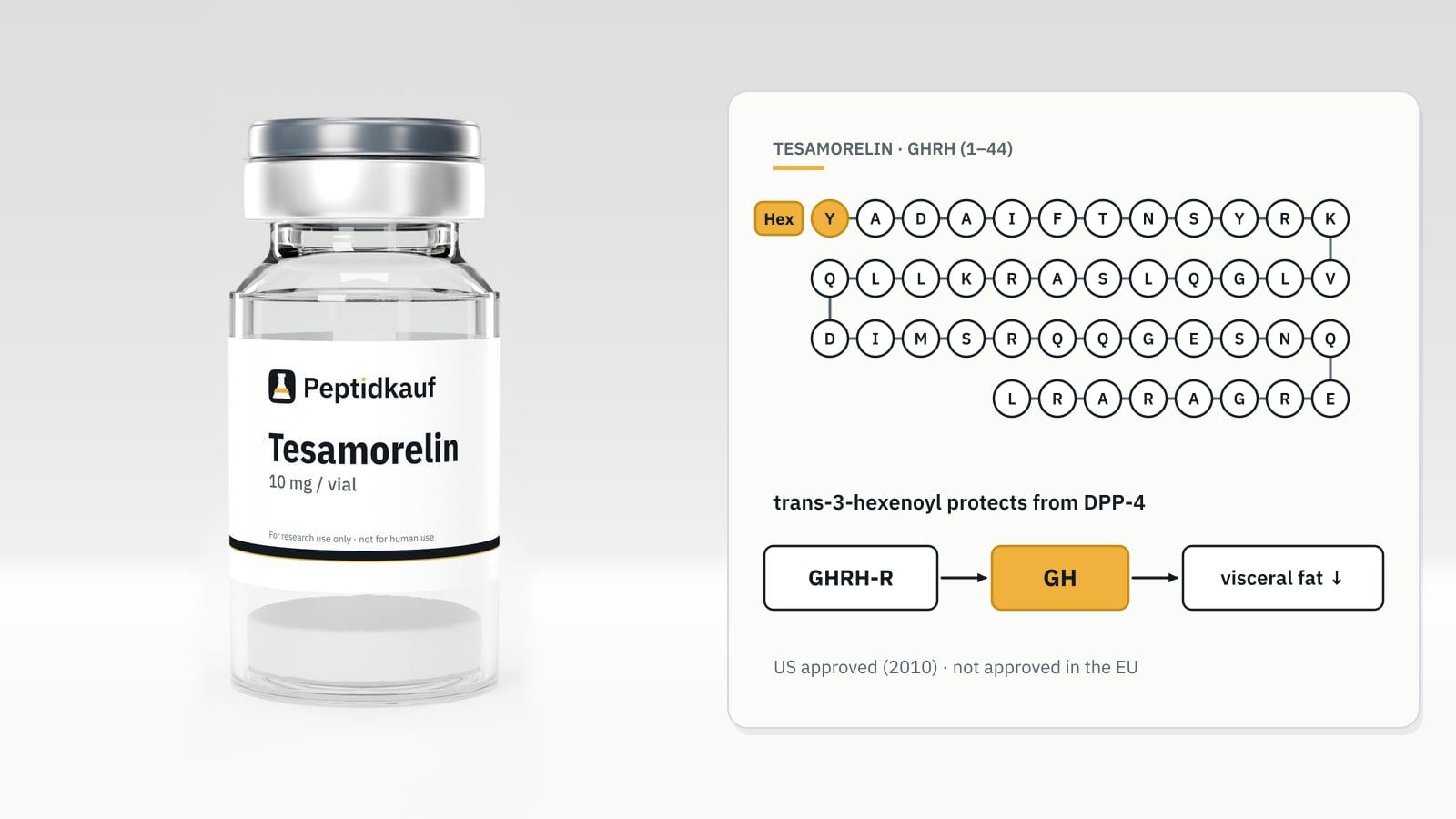
Tesamorelin is the only GHRH analogue approved as a medicine today, though only in the US and for a narrow indication. That makes it especially valuable for research: there are large placebo-controlled human trials, which is rare among peptides of the growth hormone axis. This article explains how tesamorelin is built, how it works, what the trials show and which side effects are known. It describes research and contains no usage or dosing advice.
At a glance
- Tesamorelin is full-length 44-amino-acid GHRH with a stabilising group at the start.
- It stimulates the pituitary to release growth hormone in natural pulses; IGF-1 rises.
- In phase 3 trials it reduced visceral abdominal fat in people with HIV-associated lipodystrophy.
- Approved in the US since 2010, not in the EU. It is on the WADA Prohibited List.
What is tesamorelin?
Growth hormone-releasing hormone (GHRH) from the hypothalamus consists of 44 amino acids. In blood the enzyme DPP-4 cleaves it within minutes. Tesamorelin carries the complete sequence plus a trans-3-hexenoyl group at the N-terminus. This small change protects against breakdown without changing activity at the receptor.
This sets tesamorelin apart from the shortened analogues: sermorelin covers only the first 29 amino acids, and CJC-1295 is a modified 29-residue section. How the growth hormone axis peptides relate is explained in ipamorelin, CJC-1295, tesamorelin & co..
How does tesamorelin work?
Tesamorelin binds the GHRH receptor in the pituitary and triggers growth hormone release. Unlike growth hormone given from outside, the body's own control stays in place: somatostatin still brakes, IGF-1 still feeds back, and release follows pulses. Growth hormone drives IGF-1 production in the liver and stimulates fat breakdown in adipose tissue, particularly visceral fat around the organs.
What do the studies show?
Visceral abdominal fat in HIV lipodystrophy
Some people with HIV develop fat redistribution with more abdominal fat on antiretroviral therapy. In two phase 3 trials (including Falutz et al., New England Journal of Medicine 2007), tesamorelin clearly reduced visceral fat after 26 weeks compared with placebo, while subcutaneous fat barely changed. After stopping, abdominal fat largely returned. The 2010 US approval rests on these data.
Liver fat
A randomised trial in people with HIV and fatty liver (Stanley et al., Lancet HIV 2019) found reduced liver fat and less progression of fibrosis with tesamorelin than with placebo. That makes tesamorelin interesting for liver disease research.
Cognition in older age
A study of older adults with and without mild cognitive impairment (Baker et al., Archives of Neurology 2012) described improvements in executive function after 20 weeks. The study was small; confirmation is pending.
| Area | Evidence |
|---|---|
| Visceral fat (HIV lipodystrophy) | Two phase 3 trials, basis of US approval |
| Liver fat, fibrosis | Randomised trial in HIV with fatty liver |
| Cognition | Small randomised trial in older adults |
| General obesity | Not studied as an indication |
Side effects
In the trials the main effects were injection-site reactions, joint and muscle pain, water retention and tingling in the hands, all typical consequences of raised GH and IGF-1. Blood glucose can rise and was monitored in the trials. Because IGF-1 promotes cell growth, active cancer was an exclusion criterion.
Approval and status
Tesamorelin has been approved in the US since 2010 for reducing excess abdominal fat in HIV-associated lipodystrophy. It is not approved in the EU. As a growth hormone-releasing factor it is on the World Anti-Doping Agency's prohibited list.
Tesamorelin in the lab
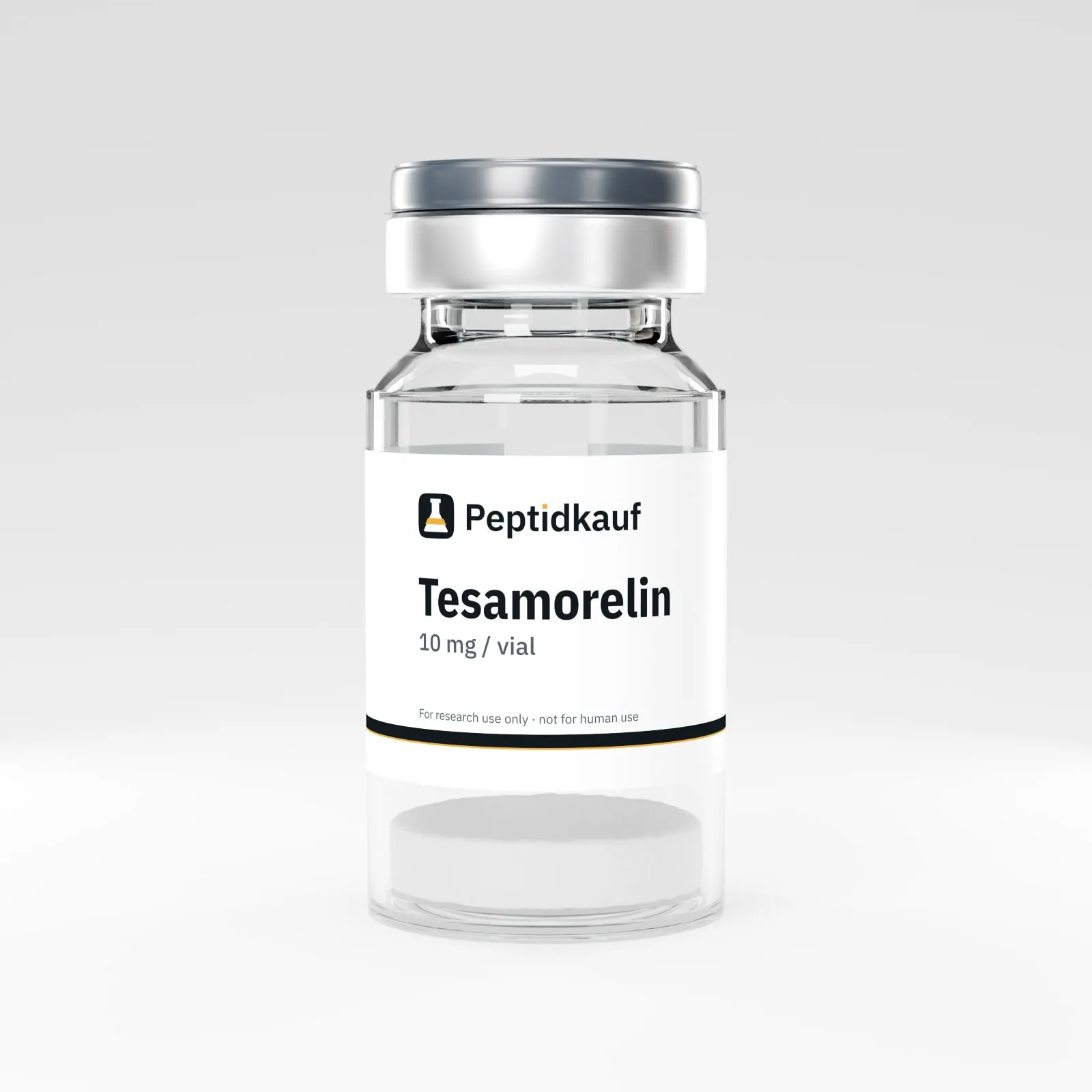
In research tesamorelin serves as a well-characterised GHRH analogue, for example for studies of pulsatile GH release, visceral fat or liver metabolism. At 44 amino acids it is much larger than sermorelin, so mass spectrometry matters particularly for identity testing. Peptidkauf offers tesamorelin as a research reagent with a lab report for every batch, as well as the blend tesamorelin + ipamorelin.
Frequently asked questions
What is tesamorelin?
A stabilised 44-amino-acid analogue of the body's own GHRH that stimulates growth hormone release from the pituitary.
What is tesamorelin approved for?
In the US, for reducing excess abdominal fat in people with HIV-associated lipodystrophy. There is no EU approval.
What is the difference between tesamorelin and sermorelin?
Sermorelin covers the first 29 amino acids of GHRH and is broken down quickly. Tesamorelin contains all 44 amino acids and a protective group at the start.
Is tesamorelin the same as growth hormone?
No. Tesamorelin stimulates the body's own pituitary to release growth hormone; it does not replace the hormone.
Conclusion
Tesamorelin is the best-studied GHRH analogue, with phase 3 data and a US approval. The evidence is strongest for visceral fat in HIV lipodystrophy, promising for liver fat and preliminary for cognition. For research it is a reference substance of the growth hormone axis.